What is GEO? Definition and KPIs in 2026

GEO (Generative Engine Optimization) covers what a company does to be named, cited and accurately described in the answers of AI assistants: ChatGPT, Google AI Mode, Google's AI Overview, Perplexity, Gemini, Claude or Grok. It is measured with four indicators: visibility rate, share of voice, sentiment and position. It complements Google search optimisation without replacing it, because assistants rely mostly on third-party sites and their answers change from one language to another and from one week to the next.
Table of Contents· 5 sections▾
Ask ChatGPT which accounting firm to choose in Lausanne, or which invoicing software would suit an SME. It answers with three or four names, a sentence on each, and sometimes the sites where it found the information. GEO is the work of getting onto that list, and being described accurately on it.
The term comes from a research paper published in November 2023, "GEO: Generative Engine Optimization" (Aggarwal et al.). In 2026 it covers a more precise reality. Several assistants each answer in their own way, and their answers change with the language of the question. Since the end of the summer, advertising has also started to appear around those answers.
GEO in one definition
GEO, for Generative Engine Optimization, covers what a company does to be named, cited and accurately described in the answers of AI assistants. In Switzerland, this mainly concerns ChatGPT, Google AI Mode, Google's AI Overview, Perplexity, Gemini, Claude and Grok.
Named and cited sound alike, but they measure different things. A brand is named when its name appears in the text of the answer. It is cited when the assistant links to one of its pages as a source. The two rarely go together, and the gap is instructive.
A search made on 6 October 2026 on google.ch, in English, shows both cases at once: "moving company Geneva quote". The AI Overview names HopMove Genève and Agence Fret Cargo in its text, and also cites them as sources. A Reddit discussion and the comparison site Sirelo appear among its other sources, without being named.
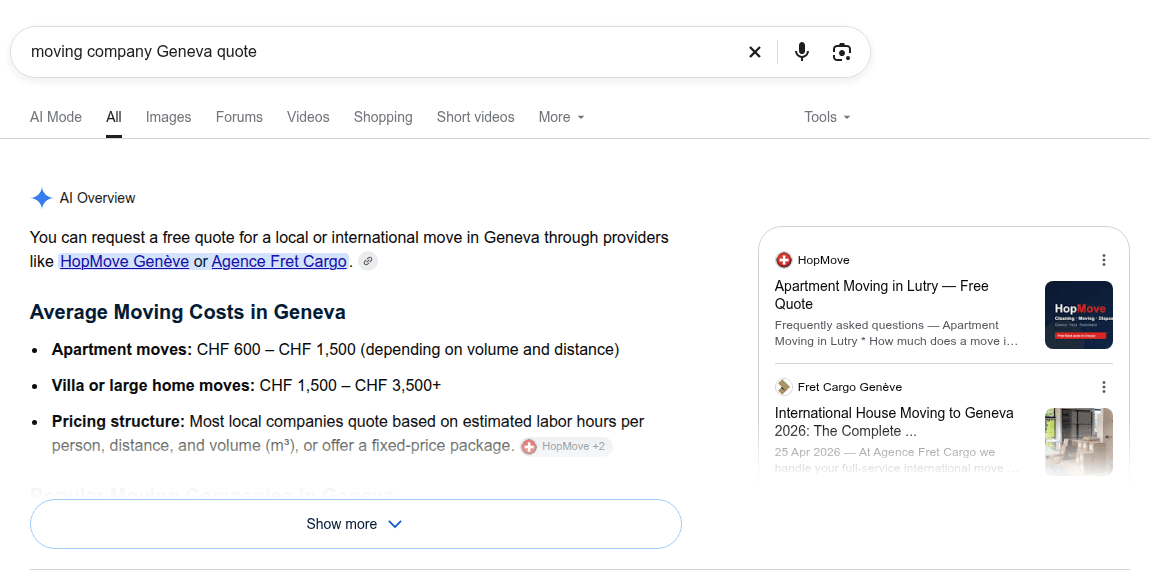
Google screenshot, October 2026.
A brand cited without being named has useful pages, but not yet enough reputation for the assistant to recommend it. A brand named without being cited is known, but its pages are not judged reliable enough to serve as a source. The work is different in each case.
The four GEO KPIs
GEO is measured on a fixed list of questions, the ones your customers actually ask, put regularly to the same assistants. Four indicators are enough to know where you stand.
| KPI | What it measures | How it is calculated |
|---|---|---|
| Visibility rate | Are you in the answer? | Answers naming the brand ÷ answers measured |
| Share of voice | Do you carry more weight than your competitors? | Brand mentions ÷ (brand mentions + mentions of tracked competitors) |
| Sentiment | What is said about you? | Tone of the answers naming the brand: positive, neutral or negative |
| Position | Do you come first? | Average rank of the brand in the answer, 1 being the first name mentioned |
Sentiment is only calculated on answers that name the brand: an answer that does not talk about you has no opinion of you. And share of voice depends on the competitors you track, so it can only be compared against the same list of competitors.
On the sources side, coverage gives the share of answers in which a site appears as a source. The citation rate gives the average number of citations per answer. Together they show which sites feed the answers in your industry, and therefore where you need to be present.
Ranking on Google is not enough
Good search optimisation helps, because assistants read the web. It does not guarantee being picked up. On the questions our observatory tracks in French-speaking Switzerland, Google displays an AI Overview in of searches, and this summary comes before the classic links. Ranking first in the links no longer says anything about presence in that block.
Above all, the AI Overview rarely relies on the brand's own website. In our corpus, of its citations point to a third-party site: a newspaper, a comparison site, a directory, an association. What the AI says about your company has therefore almost always been written elsewhere. Your website matters, but it is not enough.
This is why GEO and SEO complement each other. SEO works on your pages. GEO looks at everything that is said about you, on your site and elsewhere, and at how the assistants pick it up. The detailed comparison is in SEO or GEO.
What changed in 2026
The engines have multiplied. In 2024, the talk was mostly about ChatGPT. In 2026, the same question can receive different answers from ChatGPT, AI Mode, AI Overview and Perplexity. A brand can be recommended by one and ignored by another, which means measuring engine by engine.
Language changes the answer. For a Swiss company, this is the most underestimated point. In our automotive study, Peugeot appears in 26 % of answers in French and in 4 % of answers in German, for the same translated question (the study, in French). A presence in French-speaking Switzerland says nothing about the German-speaking part of the country.
The cause lies in the sources. When the question is asked in German, 56 % of the sites cited mainly serve the German market; in French, 51 % serve the French market; in Italian, 55 % the Italian market. Sites aimed at Switzerland stay between 13 % and 16 % in all three languages. Each language makes the assistant read the press of the neighbouring country, and much less the Swiss one.
Answers move fast. Among the pages AI Overview cited in our corpus, were cited on a single day only. A screenshot taken on a Monday describes that Monday. Only a measurement repeated on the same questions shows a trend.
Advertising is arriving. Since the end of August, ChatGPT has shown ads below its answers in Switzerland. Google already places them in its AI Overviews, in twelve countries and in English only. Ads cannot be bought inside the text of the answer: presence there remains a matter of citations. The full picture is in AI ads: ChatGPT is open in Switzerland, Google is not (in French).
Where to start
List your questions. About twenty questions your customers actually ask, written the way they would write them, in the languages of your markets. General questions about your trade, without your brand name: that is where recommendations are made.
Put them to the assistants. Note who is named, in what order, in what words, and which sites are cited. Repeat the exercise every week for a month before drawing conclusions.
Correct what is wrong. An outdated price, an old address, a service you no longer offer: the error often comes from a third-party page. Find the source and have it corrected, rather than only updating your own site.
Publish pages that answer a question. One page per question, with verifiable facts, prices in francs, real place names. Assistants are more willing to pick up a precise answer than a general presentation. What gets a page picked up is detailed in how to appear in AI Overview.
Be present where the assistants read. Comparison sites, media, directories, industry associations: these are what the assistants cite in your sector. Watching them shows where to concentrate the effort. For French-speaking Switzerland, a monthly record of the sites ChatGPT, Google AI Mode and Perplexity actually cite shows which ones carry weight in each sector.
If you hand this work to a provider, six questions to ask before signing help compare the offers.
Repliq measures every day what the assistants answer to Swiss questions, in French, German and Italian. Each month, the observatory publishes the sources they cite in French-speaking Switzerland.
See the sources assistants cite in French-speaking SwitzerlandFrequently Asked Questions
How often should I measure my visibility in AI assistants?
At least once a week, on the same questions and in the same languages. Answers change quickly: in the Repliq observatory, most of the pages cited by Google's AI Overview are cited on a single day only. One isolated measurement describes a day, not a trend. Repliq measures its campaigns twice a week and its observatory every day.
How can I find out which sources ChatGPT uses for my industry?
When ChatGPT searches the web, it shows the sites it consulted as links or small tags in the answer. Ask the questions your customers ask and note those links, over several days. Some answers cite no source at all: they come from what the model has learned, and new content will not move them quickly.
My website doesn't show up in AI answers. What can I do?
First check that the assistants' crawlers can read your site (robots.txt file, content displayed without JavaScript). Then publish pages that each answer one precise customer question, with verifiable facts. Finally, look at which third-party sites the assistants cite in your industry: that is often where a brand's presence is decided.
How do I know if AI assistants cite my competitors more than me?
Ask the same questions to the same assistants, then count who is named. Share of voice compares your mentions with those of the competitors you track. It only makes sense on a fixed list of questions, measured over time.
Does ChatGPT give the same answers in French and in German?
Not always. In the Repliq automotive study, Peugeot appears in 26 % of answers in French and in 4 % of answers in German, for the same question translated and asked on the same days. A brand present in all three language regions needs to measure each language separately.
Follow what AI answers in Switzerland
New studies, sector analyses and measured cases, with every publication. Repliq tracks ChatGPT, Gemini, Google AI Mode, Perplexity and Grok.
No sales follow-up. Unsubscribe in one click.
Measure your AI visibility
Discover how ChatGPT, Google AI Mode and Google AI Overview talk about your brand. One-off audit or continuous monitoring, your call.
Discover the AI visibility auditRelated Articles
SEO vs GEO: Why Ranking on Google Isn't Enough Anymore
SEO optimizes for search engine rankings (Google). GEO optimizes for AI answer engine mentions (ChatGPT, Gemini, Perplexity). Different goals, different tactics, both essential. SEO drives traffic through clicks. GEO influences decisions through recommendations.
Choosing a GEO agency in Switzerland: six questions
Two GEO offers at the same price can measure very different things: not the same engines, not the same questions, not the same markets. Six questions surface the gap before you sign. They cover the accuracy of the information about your company, what will actually be measured, the role of classic search optimisation, which Swiss sources are targeted, and how long the observation runs. The reference points come from Swiss Atlas, the observatory Repliq runs daily across ten sectors.
Google AI Overview: when it actually appears
AI Overview is the text Google displays above the links, written by the AI at the moment of the search. Across more than 2,800 questions asked in French-speaking Switzerland, it appears in three cases out of four. It almost always answers “how much does it cost”, almost never “where to buy”: when it is time to choose where to buy, your customers get the links back. The sources it cites are not Google's top results, and they change completely from one national language to another.