From search to recommendation: who answers for your brand in AI?
AI is turning information search into a direct recommendation where users expect arbitration. Our study of 8,800 citations shows that leading Swiss brands today control only 5 to 12% of their own narrative inside these interfaces. This guide unpacks how challengers like rappn and Magic Heidi break through with structured content, and how established brands can reclaim the conversation by becoming reference sources for the algorithms.
Table of Contents— 8 sections▾
The digital marketing paradigm is shifting. On conversational agents like ChatGPT, Google AI Mode or the AI Overview answers that now appear at the top of Google results, users no longer ask for a list of links; they ask for a reasoned recommendation. Faced with a complex query like "Which accounting software should I choose for my fast-growing SME?", AI doesn't index — it synthesises.
For established brands, this behavioural shift raises a critical question: who is supplying the AI with the arguments it uses to talk about you?
We ran a study using Repliq, a Swiss AI-visibility audit tool, on 8,800 citations recorded between April and May 2026. The verdict is unambiguous: in retail and B2B software, leading brands often own only 5 to 12% of their own narrative inside AI-generated answers. The rest is dictated by third parties.
Why AI "prefers" comparators and listicles
The data is unambiguous: large language models (LLMs) are particularly fond of "comparison guides" and "listicles" — articles structured as lists or tables. When a consumer types "Migros or Coop, which is cheaper for families?" into ChatGPT, here is what the machine paraphrases:
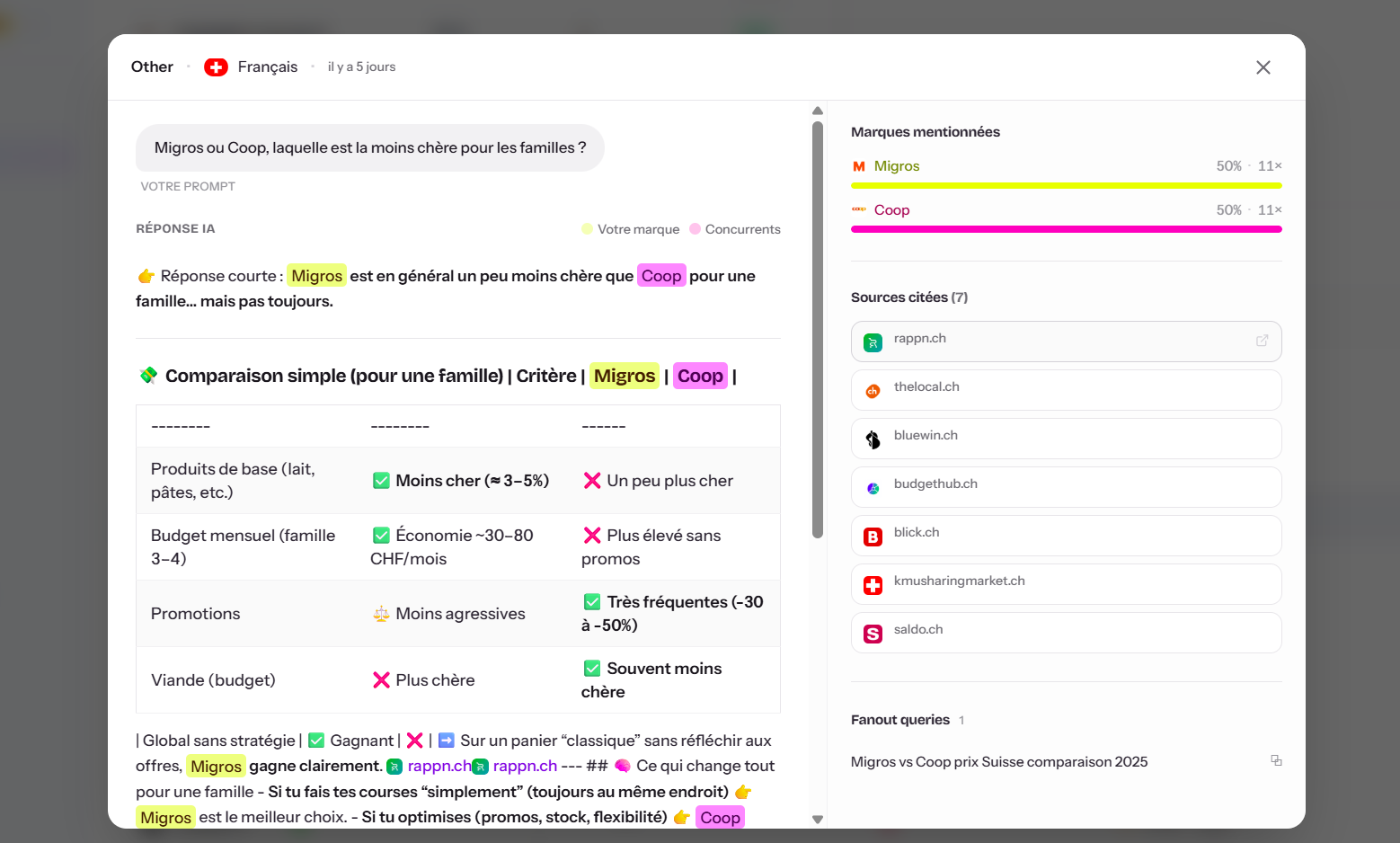
Capture d'écran du dashboard Repliq.
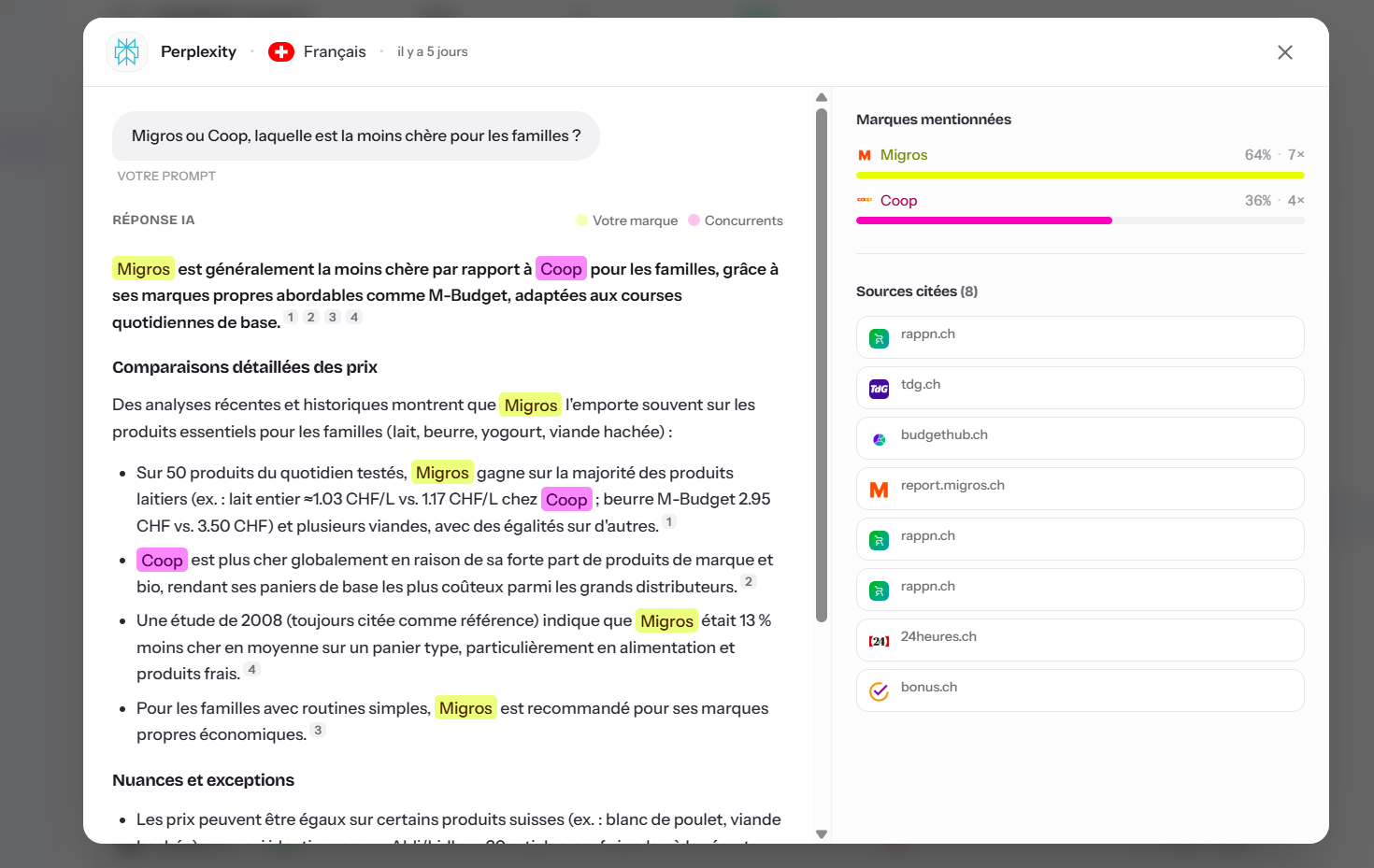
Capture d'écran du dashboard Repliq.
This is not algorithmic randomness, but a response to user intent. In a conversational interface, the user expects arbitration. AI therefore prioritises sources that have already done the work of structuring information — a "pros / cons" comparison table is more directly usable than a product page.
The distribution observed in our Swiss food-retail readings confirms the mechanic. Third-party comparators and listicles concentrate two thirds of citations. The brands themselves — Migros, Coop, Aldi, Denner, Lidl, Manor — barely add up to one citation in ten.
Who gets cited when AI answers, Swiss food retail
Categorisation of 3,677 citations across 40 prompts.
Study run via the Repliq AI-visibility audit tool, on ChatGPT, Google AI Mode, Google AI Overview and Perplexity, from 18 April to 2 May 2026.
The challengers' playbook: leading by data
Two recent Swiss examples show how companies still relatively unknown to the wider public understood this mechanic before the established brands did, and quickly captured the search expressions inside AI.
In retail: rappn.ch
On Swiss food-price comparison queries, a young platform — rappn.ch, less than a year old — captures a meaningful share of voice ahead of the sector's giants. Across 27 distinct comparative prompts, the site appears at an average position of #4 in AI answers and is in the top 3 cited sources in 47% of cases.
Why? Because it answers the search expression precisely with segmented, multilingual data. Concretely, the platform has published four types of content that LLMs gladly pick up:
- One page per comparison pair that users actually search for — "Migros or Coop, which is cheaper", "Cumulus vs Supercard", "Coop vs Aldi". Not a generic homepage, but one article per question.
- Coverage in four languages (French, German, English, Italian) on the same content, which lets multilingual models retrieve the information regardless of the query's idiom.
- A structured table format explicitly comparing retailers on the criteria users care about — prices, promotions, private labels, meat, fresh produce.
- Dated H1 tags ("2026") that signal to models that the content is up to date.
In B2B: Magic Heidi
The Magic Heidi case is different and equally instructive. Magic Heidi is an accounting software for freelancers and sole proprietors, younger than Bexio (the established leader of the Swiss SME market) and aimed at a narrower niche. The brand is cited almost as often as Bexio itself on B2B comparison queries — 241 times against 248 for Bexio.
Their strategy? A structured annual guide that honestly analyses the strengths and weaknesses of available solutions, including their competitors. Not product content, not a sales page. A guide AI can paraphrase as a credible synthetic answer.
Top sources cited by AI on queries activating Bexio
Citations across 5,133 measurements, 32 prompts, May 2026.
Study run via the Repliq AI-visibility audit tool, Swiss SME accounting-software sector.
Out of 100 sources ChatGPT cites when an executive asks which accounting software to choose, roughly 5 come from Bexio itself. The other 95 come from third-party sites — including Magic Heidi, which has published one single structured annual guide and now weighs as much as the dominant brand on the market.
Beyond the "hack": content durability
It would be tempting to read these examples as a simple short-term tactical opportunity. However, much like Google's Helpful Content updates between 2022 and 2024, AI models are constantly refining their selection criteria.
Our three weekly observation cycles already reveal the volatility of the ecosystem. On Swiss food queries, the Michelin Guide lost more than two thirds of its citations in two weeks (from 27 to 6). Gault & Millau dropped by a third over the same period. Conversely, platforms such as rappn.ch consolidated their position. This volatility shows that historic notoriety no longer guarantees visibility: AI prioritises structure and immediate relevance to the question asked.
The editorial ecosystem moves in weeks, not years
Trajectory of four sources cited on Swiss food queries, between 18 April and 2 May 2026.
Study run via the Repliq AI-visibility audit tool, 3 consecutive weekly cycles.
Purely opportunistic techniques — automated content, shallow lists, URL structures designed for models alone — risk being downranked by future LLM updates in favour of real authority and data reliability.
The durability principle: for an established brand, the goal is to become the "source of truth" on its segment. This is not achieved through algorithmic manipulation, but by making available high-value data that AI can use to serve the user.
Becoming a reference source in the conversation
A brand has to understand that it is no longer addressing only a reader, but an agent that will "discuss" its products with a potential customer. To be cited positively, the content strategy must orient itself around four axes:
Real utility. Publish the data your customers actually search for: cost comparisons, use-case buying guides, performance analyses. Not marketing content disguised as a guide, but content a customer would be willing to pay for before a purchase.
Structure. Make the AI models' job easier with clear, dated, hierarchical data. Comparison tables, structured FAQs, quantified data. Content readable by a human AND digestible by a model.
Editorial honesty. AI looks for nuanced answers. A brand able to position its product objectively within an ecosystem — including by mentioning competitors' strengths — gains credibility with the model. That is exactly what Magic Heidi does, and that is why its guide is paraphrased.
Multilingual coverage. In Switzerland, AI is polyglot. A brand publishing only in French leaves the field open for Swiss-German or international sources to answer queries in the other national languages. That is precisely what allowed rappn to capture queries in four languages simultaneously, and Magic Heidi to dominate the conversation on the German-speaking side while its French-speaking competitors stayed barely present there.
Inspiration: what data do you already own?
Most companies hold treasure troves of comparative information internally that they have never formalised into published content. A few concrete leads, sector by sector:
- Window-blind specialist: objective comparison of screen, canvas and Venetian fabrics by orientation and sun exposure.
- Pool builder: polyester shell vs liner vs concrete — total cost of ownership over ten years by climate.
- Real-estate manager: observed rental yields by neighbourhood, with standard deviations and comparison to cantonal medians.
- Optician: objective comparison of progressive lenses by supplier, with real prices and clinical observations.
- Digital agency: average acquisition cost per Meta vs Google campaign by SME size and sector.
- Private bank: comparison of the number of available funds and the methodological quality of their selection.
- Garage: observed annual maintenance cost by brand for a five-year-old vehicle.
- Independent tour operator: comparison of Alpine resorts by profile — family, sport, budget.
For each example, the data exists in-house. It simply has never been formalised into content accessible to users — or to AI models. By formalising this data into structured content, you reclaim the conversation in places AI assistants are currently giving away to third parties.
Conclusion: anticipating the recommendation
Classic SEO is not disappearing, but it is being doubled by a new discipline: optimisation for answer engines, or GEO (Generative Engine Optimization). Your brand's narrative inside AI is not a technological inevitability, it's an editorial opportunity.
On the questions your customers ask AI every day, are you the source or the subject?
Measure my AI visibility for freeFurther reading
- What is GEO? — the discipline's definition and how it differs from classic SEO.
- SEO vs GEO: what changes with answer engines? — why both logics coexist and complement each other.
- 4 strategies to improve a brand's AI visibility — concrete levers, broken down by company profile.
- The 3 KPIs of answer engines — visibility, share of voice, sentiment: how to measure them.
- How to audit a brand's AI visibility — full methodology of a GEO audit.
Methodology in brief
This study is based on continuous tracking via the Repliq AI-visibility audit tool of the main consumer-facing conversational agents — ChatGPT, Google AI Mode, the AI Overview answers now appearing at the top of Google results, and Perplexity. Three consecutive observation cycles between 18 April and 2 May 2026.
Scope: 72 prompts in French and German, on two representative sectors.
- Swiss food retail: 40 prompts in French, measured on Migros and Migros Restaurants. 3,677 citations recorded across three cycles.
- SME accounting software: 32 prompts (17 in French, 15 in German), measured on Bexio. 5,133 citations recorded across three cycles.
External sources: comparison with Google.ch indexing covers six targeted queries analysed via standard SERP audit tools in May 2026.
See the 40 food-retail prompts(40)
Français (40)
- Aldi Suisse, la qualité est-elle comparable à Migros ?
- Autogrill autoroute, quelles stations proposent encore de la cuisine fraîche ?
- Avis sur le service client Manor en 2026.
- Caisse enregistreuse connectée pour un petit commerce à Genève.
- Comment choisir un restaurant étoilé Michelin en Valais ?
- Comment profiter des actions hebdomadaires dans les supermarchés à Lausanne ?
- Comparatif prix des fruits et légumes en Suisse romande en 2026.
- Denner tient-il vraiment ses prix face à Aldi Suisse ?
- Fiduciaire spécialisée restauration à Fribourg, laquelle choisir ?
- Fournisseur boulangerie bio pour restaurant PME à Lausanne.
- Fournisseur grossiste boissons pour restaurant PME à Lausanne.
- Grossiste boissons pour restaurateur à Genève en 2026.
- Holy Cow est-il toujours le meilleur burger à Lausanne en 2026 ?
- IKEA Restaurant Aubonne, les plats suédois valent-ils le détour ?
- Import grossiste produits bio pour épicerie indépendante en Suisse.
- La carte Cumulus Migros vaut-elle la Supercard Coop ?
- Logistique e-commerce pour PME romande, quelles solutions ?
- Manora ou Migros Restaurants, quel buffet propose le meilleur rapport qualité-prix ?
- Manora Vevey vaut-il le déplacement pour un Fribourgeois ?
- Meilleures boutiques d'occasion pour les enfants à Bâle.
- Meilleures enseignes de discount alimentaire en Suisse romande.
- Meilleures pizzerias tenues par des Italiens à Neuchâtel.
- Meilleurs cafés de spécialité à Lausanne pour télétravailler.
- Meilleurs restaurants de fondue authentique à Fribourg en 2026.
- Meilleurs restaurants végétariens à Genève au centre-ville.
- Migros ou Coop, laquelle est la moins chère pour les familles ?
- Migros Restaurants Lausanne ou Migros Restaurants Genève, lequel offre la meilleure expérience ?
- Où acheter des produits du terroir valaisan à Sion ?
- Où acheter du vin suisse de qualité à Neuchâtel ?
- Où déjeuner rapidement et sainement à Berne le midi ?
- Où faire ses courses en ligne en Suisse avec livraison gratuite ?
- Où manger une raclette de qualité à Lausanne pour moins de 50 CHF ?
- Où trouver le meilleur brunch dominical à Zurich ?
- Où trouver les meilleures offres M-Budget chez Migros en Suisse romande ?
- Plateforme de réservation pour restaurateur indépendant à Neuchâtel.
- Quels centres commerciaux à Zurich pour un samedi shopping ?
- Quels produits bio sont les moins chers en Suisse ?
- Quels supermarchés livrent à domicile à Genève en 2026 ?
- Top burgers bio en Suisse romande en 2026.
- Top restaurants gastronomiques de la campagne vaudoise en 2026.
See the 32 accounting-software prompts(32)
Français (17)
- Cherche un logiciel pour simplifier la facturation des PME.
- Cherche un logiciel pour simplifier la facturation des PME.
- Comment Bexio se positionne-t-il par rapport aux autres logiciels de gestion pour PME en termes de fonctionnalités ?
- Est-ce que Bexio est une bonne option pour la facturation d'une PME comparé à d'autres solutions sur le marché ?
- J'ai besoin d'un logiciel qui me permette de générer facilement des devis et de les transformer en factures personnalisées pour mes clients.
- Je suis dirigeant d'une PME et je cherche un outil de comptabilité simple et efficace pour gérer mes comptes sans expert-comptable.
- Où trouver un logiciel de gestion pour PME en Suisse ?
- Où trouver un logiciel pour automatiser la comptabilité ?
- Propose un logiciel de facturation pour PME en ligne.
- Que disent les clients et les avis sur Bexio et ses produits/services ?
- Que penses-tu de Bexio ?
- Quelle est la réputation de Bexio concernant sa solution de comptabilité en ligne pour les PME ?
- Quelle solution de comptabilité pour PME est la plus simple ?
- Quelle solution de comptabilité pour PME est la plus simple ?
- Quels sont les meilleurs logiciels de gestion pour PME en Suisse en 2026 ?
- Quels sont les principaux points forts et faibles de Bexio ?
- Suggère un logiciel de comptabilité adapté aux indépendants.
Allemand (15)
- Ich bin KMU-Geschäftsführer und suche ein einfaches und effizientes Buchhaltungstool, um meine Konten ohne Treuhänder zu verwalten.
- Ich suche ein Tool für mein KMU, um die Kunden-, Projekt- und Lagerverwaltung zu zentralisieren. Welche Lösung empfehlen Sie mir?
- Ist Bexio eine gute Option für die Rechnungsstellung eines KMU im Vergleich zu anderen Lösungen auf dem Markt?
- Such einen einfachen Buchhaltungssoftware für kleine Unternehmen.
- Suche nach Software, um die Rechnungsstellung für KMU zu vereinfachen.
- Was denkst du über Bexio?
- Was sagen Kunden und Bewertungen über Bexio und seine Produkte/Dienstleistungen?
- Was sind die wichtigsten Stärken und Schwächen von Bexio?
- Welche Online-Buchhaltungssoftwares für KMU sind 2026 am besten empfohlen?
- Welche Rechnungssoftware ist im Jahr 2026 am besten für kleine und mittlere Unternehmen (KMU) geeignet?
- Welches sind die besten Verwaltungssoftwares für KMU in der Schweiz im Jahr 2026?
- Wie hilfreich ist Bexio bei der Rechnungsstellung für KMU?
- Wie ist der Ruf von Bexio bezüglich seiner Online-Buchhaltungslösung für KMU?
- Wie positioniert sich Bexio im Vergleich zu anderen Verwaltungssoftwares für KMU in Bezug auf Funktionen?
- Wo finde ich eine Verwaltungssoftware für KMU in der Schweiz?
See the 6 queries compared on Google.ch(6)
Français (6)
- coop ou migros
- Migros ou Coop laquelle est la moins chère
- meilleur supermarché discount Suisse
- comparateur prix courses Suisse
- logiciel comptabilité PME suisse
- meilleur logiciel ERP Suisse PME
Frequently Asked Questions
Why do AI assistants prefer comparators and listicles over brand pages?
In a conversational interface, users expect arbitration, not a list of links. Models therefore favour sources that have already done the comparative work — guides, listicles, structured articles — to produce a synthetic recommendation. It's the amplification of a phenomenon already visible on Google, but in a paraphrased rather than listed format.
What kind of content should a brand publish to exist in AI agents?
Three criteria: real utility (publish the data customers actually look for, cost comparisons, use-case buying guides), structure (clear, dated, hierarchical data), and editorial honesty (situate your product objectively in an ecosystem, including the strengths of competitors). Purely opportunistic techniques will be downranked by future LLM updates.
Is classic SEO disappearing with conversational AI agents?
No. It is being complemented by a new discipline called GEO (Generative Engine Optimization), which specifically targets presence in LLM-generated answers. Both logics coexist: Google remains a major entry point, but a growing share of comparison queries now flow directly through ChatGPT or via the AI Overview answers that appear at the top of Google.
Follow what AI answers in Switzerland
New studies, sector analyses and measured cases, with every publication. Repliq tracks ChatGPT, Gemini, Google AI Mode, Perplexity and Grok.
231,496
assistant answers measured
1.3 million
cited sources recorded
No sales follow-up. Unsubscribe in one click.
Measure your AI visibility
Discover how ChatGPT, Google AI Mode and Google AI Overview talk about your brand. One-shot audit or continuous monitoring — your call.
Discover the AI visibility auditRelated Articles
AI Visibility: The 4 Strategic Variables to Define Before You Measure
Your AI visibility depends on 4 strategic variables: which prompts you measure, which sources feed you, which AI platform you prioritize, which languages and regions you target. These are decisions to make upstream of any measurement, not technical adjustments. Demonstrated with real Swatch data.
The AI Visibility Audit: The First Step Before Any Optimization Strategy
An AI visibility audit analyzes your current presence on ChatGPT, Gemini, and Perplexity: how often you're mentioned, with what sentiment, for which questions. It's the essential starting point before any GEO strategy.
The 3 Essential GEO KPIs: Visibility, Sentiment, Recommendation
GEO is measured with 3 essential KPIs: Visibility (are you mentioned?), Sentiment (how are you described?), and Recommendation (are you suggested as a solution?). These metrics replace traditional SEO rankings for evaluating your presence on ChatGPT, Gemini, and Perplexity.