Google AI Overview: when it actually appears
AI Overview is the text Google displays above the links, written by the AI at the moment of the search. Across more than 2,800 questions asked in French-speaking Switzerland, it appears in three cases out of four. The rate drops to 23.4 % on price and purchase searches, which is where your customers decide. The sources it cites are not Google's top results, and they change completely from one national language to another.
Table of Contents— 7 sections▾
Type your company name into Google. There is a good chance a block of text appears above the links, with a few sources on the side. That text describes you, and you did not choose its words.
This is AI Overview. Since April 2026 we have been asking Google the same questions every day across ten sectors of the Swiss-French market. measurements later, what stands out is not what you would expect.
On scope. These figures come from the French-speaking Swiss market, where our observatory runs. The mechanics hold for the whole country, the specific source lists do not.
It is not a well-ranked result
A classic result is a page that already exists and that Google orders. An AI Overview is a text written for the occasion, from several pages, a few of which are cited with a link.
The difference matters for your company. You do not appear there because you rank well, but because Google judged it useful to cite you while composing its answer.
Two neighbours not to confuse. The featured snippet, which Google has shown for years, lifts a passage from a single page without rewriting it. AI Mode is a separate conversational interface: it does not appear in the results page.
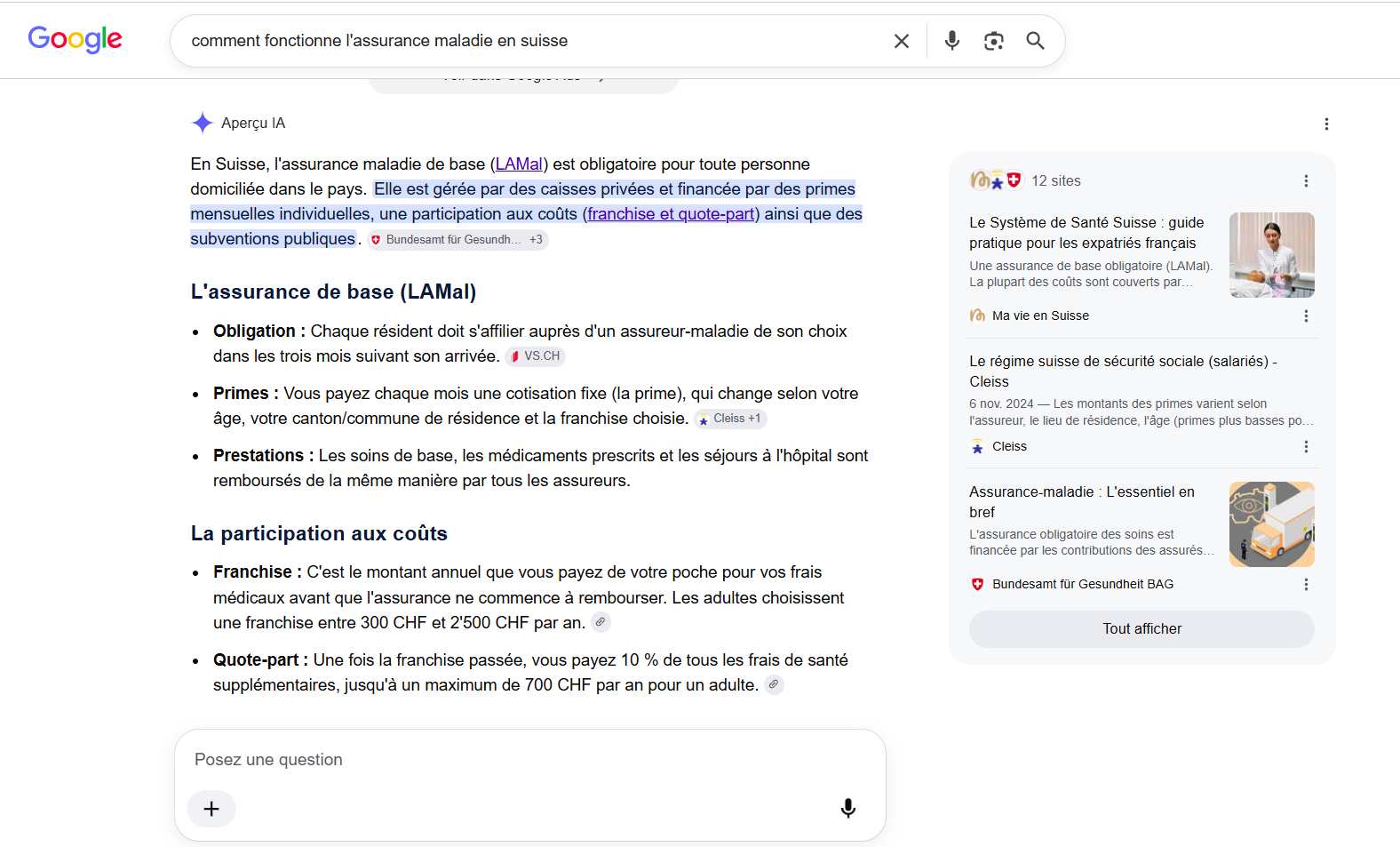
Screenshot of Google AI Overview, August 2026.
The two selections have nothing to do with each other. On this search, AI Overview cites Ma vie en Suisse first and Cleiss second. In the classic links for the same question, the Federal Office of Public Health comes top and Cleiss does not appear at all.
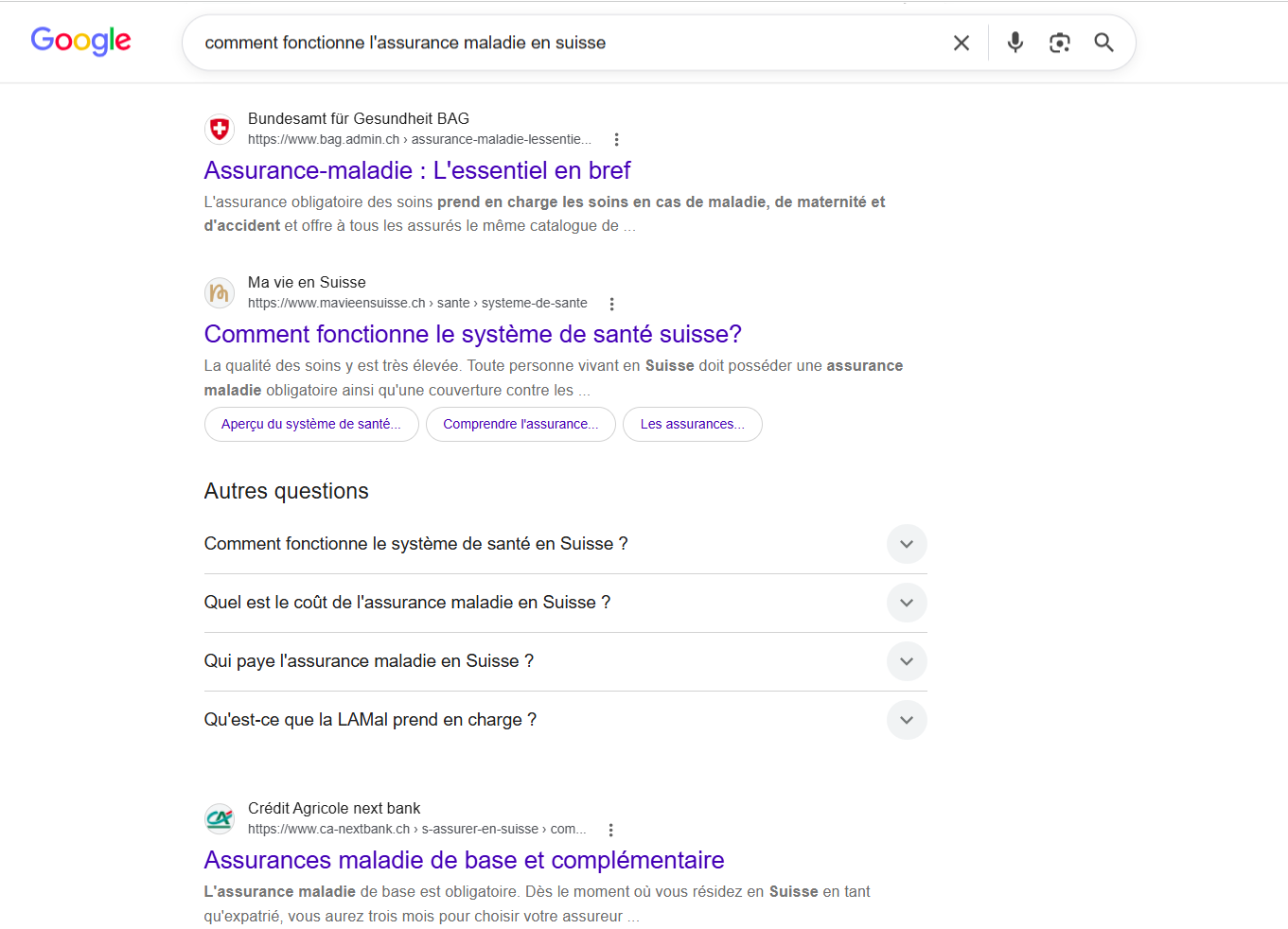
Screenshot of Google, Web tab, August 2026.
Ranking well therefore does not guarantee being cited. On mobile, where most searches happen, the block often fills the entire first screen: you have to scroll to reach the first link.
Sixteen months ahead of France
The timeline explains why these figures exist here and nowhere else in French.
| Market | Rollout | Languages |
|---|---|---|
| United States | May 2024 | English |
| Switzerland | 26 March 2025 | French, German, Italian, English |
| France | 22 July 2026 | French |
Switzerland received AI Overview sixteen months before France, and in its four national languages at once. The French delay came from negotiations between Google and press publishers over neighbouring rights.
That gap has a practical consequence. French-speaking Switzerland is a French-language market with sixteen months of hindsight on the phenomenon. The figures below come from there, not from a transposed American study.
It does not always appear, and rarely at the point of purchase
Across our questions, AI Overview answers in of cases. One search in four still happens without it.
That average hides the essential.
When AI Overview appears, by type of question
Share of searches producing an AI Overview.
Swiss Atlas, Repliq observatory. Over 2,800 questions asked of Google in French-speaking Switzerland, since April 2026.
On price and purchase questions, AI Overview appears nearly four times less often. Just as your customer approaches the decision, Google largely stops answering in their place and sends them to the links.
That is a rarely stated piece of good news: the part of the journey closest to the sale remains the one your search optimisation already works on.
A caution on reading, all the same. 23.4 % does not mean never. Of four purchase searches, one still produces an AI Overview. This segment holds 94 measurements, the smallest of the five, so the exact value needs a margin.
When someone types your company name
| Type of search | Measurements | AI Overview appears in |
|---|---|---|
| Brand search | 732 | 82.4 % |
| Sector search | 1,636 | 69.4 % |
Thirteen points apart. When a prospect types your company name, Google produces a summary in more than eight cases out of ten. That summary describes you in words you did not choose, from third-party sources.
The explanation probably lies in risk. A brand search has a stable, verifiable answer. A search of the type "which solution should I choose" calls for a comparative judgement, which Google takes on less willingly.
What it cites, and what it ignores
AI Overview is the most frugal of the four engines we track: six sources at the median, against nine for Perplexity. There are fewer places to take. In exchange, it almost always cites its sources, whereas ChatGPT answers with none one time in five.
The type of page retained is more telling still.
| Type of page cited | AI Overview | Other engines |
|---|---|---|
| Editorial article | 34.2 % | 27.0 % |
| Practical guide | 7.6 % | 4.7 % |
| Listing or profile | 5.6 % | 8.5 % |
| Homepage | 5.4 % | 9.6 % |
Swiss Atlas, April to August 2026.
Your homepage has markedly less chance of being retained by AI Overview than by the other engines. An article or a guide has markedly more. Many companies do the opposite and concentrate their effort on the homepage.
Format counts too. An AI Overview runs 250 words at the median, about 2,900 characters. It is a summary, not an exposition, and it lifts short passages.
One received idea deserves to be set aside: there is no closed club. Our 10,759 citations spread across 2,002 distinct sites, and the top ten gather only 14.1 % of them. Reddit and YouTube come first, at just 2.6 % and 2.0 %, which mostly shows the dispersion. Space is therefore won across a great many sites, not by targeting three platforms.
The same question in three languages, three different answers
We asked the same question about Swiss health insurance on google.ch in French, Italian and German, on the same day.
| 1st source cited | 2nd | 3rd | Sites | |
|---|---|---|---|---|
| French | Ma vie en Suisse (blog) | Cleiss | FOPH | 12 |
| Italian | Comparis (comparison site) | Sanitas | Priminfo | 14 |
| German | Wise (fintech) | Swiss Life | CSS | 11 |
No common source in first position. Even the name of the block changes: Aperçu IA in French, AI Overview in Italian, Übersicht mit KI in German.
For a company active in Geneva and Zurich, the consequence is direct. You can be well cited in German and absent in Italian on the same question, without a French-language measurement ever flagging it.
This comparison covers a single question. It illustrates the phenomenon, it does not measure it.
How to get the links without the block
Common question, short answer: AI Overview is not a feature you switch on. Google displays it when it judges it useful, which explains the 26.6 % of searches with no block.
There is no option to disable it permanently. You can however get only the classic links by clicking the "Web" tab, in the filter bar under the search box.
That tab also works as a control tool. It lets you compare, on the same question, what the generated answer says and what the links say. That is exactly the manipulation behind the two screenshots above.
What you can do
There is no button and no purchasable slot. Google picks its sources while composing the answer. On regularly cited pages, four points recur.
Short sections. Around 220 to 250 words, each answering one precise point. An engine lifts a passage, not a whole article.
Verifiable figures. Amounts, dates, percentages. A page with no data is rarely cited on a question that calls for one.
One question per page, rather than a theme covered in general.
Third-party sources. Being picked up by a comparison site or a newspaper weighs more than a well-written internal page. Our measurements show comparison sites are the second most cited source category, with 16.1 % of citations.
Three consequences follow for how you steer. Position in the links no longer says anything about presence in the block: these are two separate measurements. Third-party sources weigh more than your own site. And purchase intent remains classic ground, where search optimisation keeps its full value.
This work has a name, GEO. If you are considering handing it to a provider, we have listed the six questions to ask before signing.
Method and limits(4)
- Corpus. Swiss Atlas, Repliq's observatory across ten sectors of the French-speaking Swiss market. Questions asked in French. These results do not hold for Switzerland as a whole.
- Trigger. A measurement counts as triggered when the search returns an AI Overview with non-empty text. Empty answers count as not triggered.
- Segmentation. Deterministic rule applied to the question text, identical to the one used in production. The purchase and price segment holds 94 measurements, the smallest of the five.
- Window. 20 April to 6 August 2026, excluding the technical ramp-up week.
These figures move. The observatory is updated monthly, and the results by sector are public.
See the sources cited in French-speaking SwitzerlandFrequently Asked Questions
What is Google AI Overview?
The text Google displays at the top of the results page, above the links. It is written by artificial intelligence at the moment of the search, from several pages, and cites a few sources. It is not a well-ranked page: it is a text that did not exist before your question.
When does AI Overview trigger?
Not on every search. Across more than 2,800 questions asked in French-speaking Switzerland since April 2026, it appears in three cases out of four. The gap comes from the type of question: 84.1 % on practical questions, against 23.4 % on price or purchase searches.
How do you turn off AI Overview?
There is no option to disable it permanently. Google displays it when it judges it useful. You can however get only the classic links by clicking the "Web" tab, in the filter bar under the search box.
Does AI Overview cost traffic?
It can reduce clicks, since the visitor finds their answer without opening a page. It also shifts visibility: being cited in the block places your company inside the answer itself. The two are measured separately, and your position in the links says nothing about your presence in the block.
How do you appear in an AI Overview?
There is no button and no purchasable slot. Google picks its sources while composing the answer. On regularly cited pages, four points recur: short sections of 220 to 250 words, verifiable figures, one question per page, and pickup by third-party sites such as comparison sites or the press.
Follow what AI answers in Switzerland
New studies, sector analyses and measured cases, with every publication. Repliq tracks ChatGPT, Gemini, Google AI Mode, Perplexity and Grok.
231,496
assistant answers measured
1.3 million
cited sources recorded
No sales follow-up. Unsubscribe in one click.
Measure your AI visibility
Discover how ChatGPT, Google AI Mode and Google AI Overview talk about your brand. One-shot audit or continuous monitoring — your call.
Discover the AI visibility auditRelated Articles
The 3 Essential GEO KPIs: Visibility, Sentiment, Recommendation
GEO is measured with 3 essential KPIs: Visibility (are you mentioned?), Sentiment (how are you described?), and Recommendation (are you suggested as a solution?). These metrics replace traditional SEO rankings for evaluating your presence on ChatGPT, Gemini, and Perplexity.
Share of Model: definition, calculation and reliability
Share of Model measures how often a brand appears in answers generated by answer engines (ChatGPT, Google AI Mode, Google AI Overview, Perplexity, Gemini) across a defined set of questions. Its definition is broadly agreed on, its calculation method far less: the choice of denominator, the exclusions and the deduplication rule shift the result by tens of points. Across 8,261 measured answers, the metric proves stable week to week and markets remain fragmented.
What is GEO? Complete Guide 2025
GEO (Generative Engine Optimization) is about optimizing your brand's presence in responses from generative AIs like ChatGPT, Gemini, and Perplexity. Unlike SEO which targets traditional search engines, GEO targets AI answer engines that synthesize information and directly recommend brands to users.