When AI gets your company wrong, the error rarely comes from your site

The investment of recent years went into the website: the right information, navigation that leads the user to the right page. AI now reduces all of that to an answer a few lines long, drawing 90 % of its cited pages from third parties, from comparison sites to directories, press and forums. One answer in 14 carries at least one false statement, and every organisation we track has one in circulation. Repliq's Reliability feature compares each measured answer against your official information, then traces the page feeding the error.
Table of Contents· 6 sections▾
A municipality publishes its counter opening hours. A hospital publishes the number of its emergency department. A company publishes its price list. That information is accurate, current and easy to find.
Ask an AI assistant the same question. The answer arrives as a single paragraph, with no list of links, no page to open. It is usually right. Sometimes not.
What changed is not the quality of websites. It is that the person asking no longer visits them. They read an answer written by a machine that read something else.
Assistants mostly read elsewhere
Across the answers Repliq analyses, assistants cite thousands of pages when talking about the brands we track. One citation in ten points to the brand's own website. The other nine are third-party pages: comparison sites, professional directories, press articles, neighbouring institutions, forums.
In other words, what an assistant says about your company was almost always written somewhere else. You did not choose those pages, you do not keep them current, and you usually do not know they exist. To get a sense of them in your own industry, Repliq tracks the sites assistants cite most in French-speaking Switzerland every month, sector by sector.
This is the shift many marketing teams have not yet measured. The work of recent years went into a clear website, navigation that leads to the right department, contact pages kept up to date. That work still matters. It no longer controls what is said.
One answer in 14 contains false information
An assistant's answer contains several verifiable statements: an address, an opening time, a price, a condition. Repliq compares each one against the official information the brand itself has confirmed.
One answer in 14 contains at least one false statement. Not a shade of wording: a wrong figure, an offer that does not exist, a contact that does not answer.
And the finding that stands out most: every organisation tracked, without exception, has at least one false statement in circulation. Including those whose website is beyond reproach.
The gap between sectors is clear. Commercial companies, whose prices and features are picked up by many comparison sites, fare better. Public institutions show three to six times more faulty answers, because their information is spread across a municipality, a canton and a partner establishment, and assistants blend those levels.
What makes the error hard to find
A marketing team has tools to monitor what gets published about its brand. None of them really helps here.
An assistant's answer is not published. It is produced for one person, once, and exists nowhere afterwards. Conventional media monitoring cannot see it.
The answer is rephrased. The assistant does not copy the faulty page, it paraphrases it. Searching for the exact sentence returns nothing.
And the answer blends sources. A single paragraph can assemble three pages, two of them accurate and one wrong. Seen from outside, the answer reads as uniform and confident.
Errors are therefore found by accident. A customer calls quoting a price nobody charges. A patient turns up at the wrong building.
How the Reliability feature works
Repliq's Reliability feature continuously compares what assistants state against what you publish.
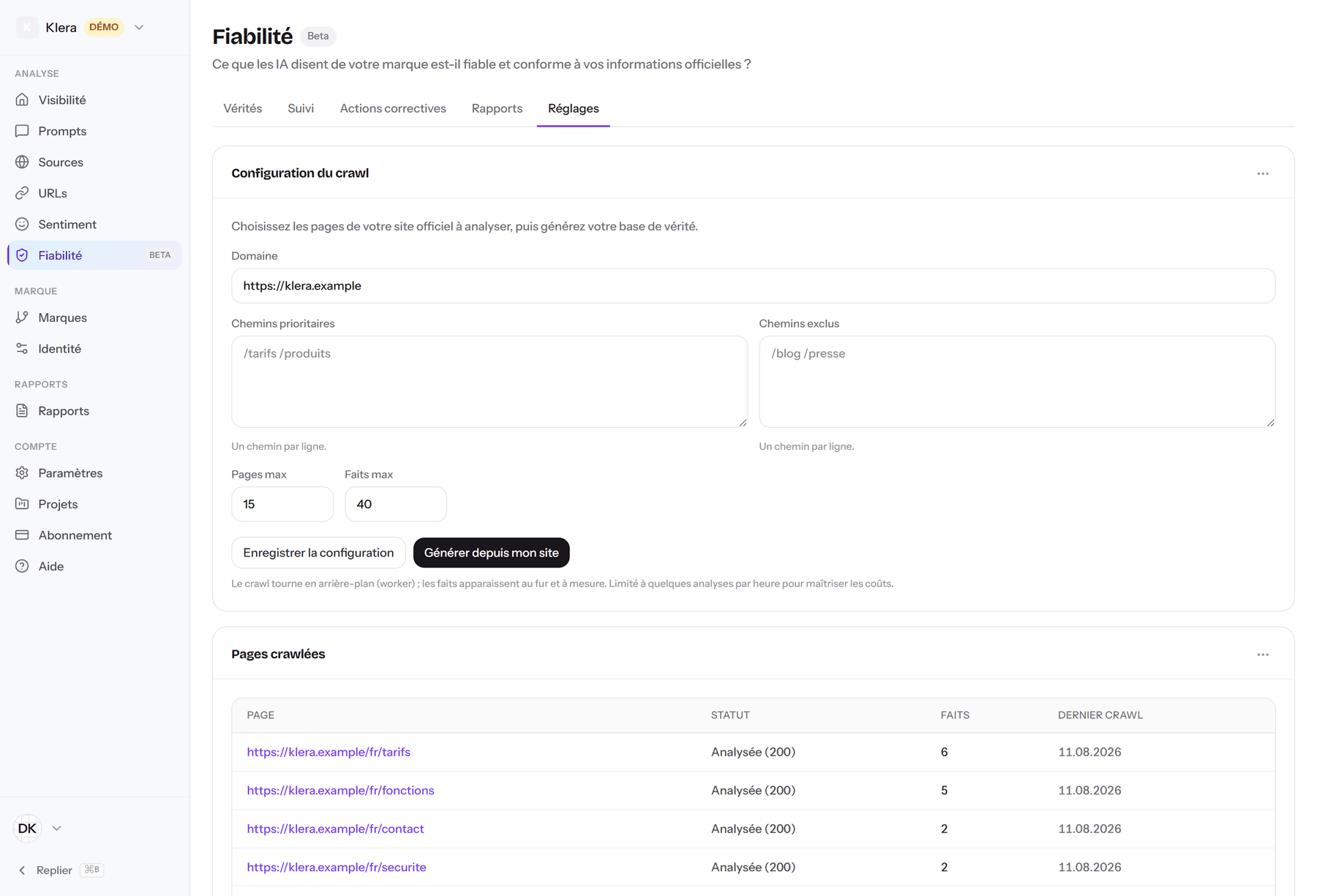
Your official statements are taken from your own website. The module reads your pages and draws 15 to 20 statements from them: what you sell, at what price, where you are found, how you are reached, what your conditions are. Each one arrives with the link to the page it comes from and the exact sentence found there, so it stands on its own against anyone who disputes it.
Repliq Reliability module. Interface in French.
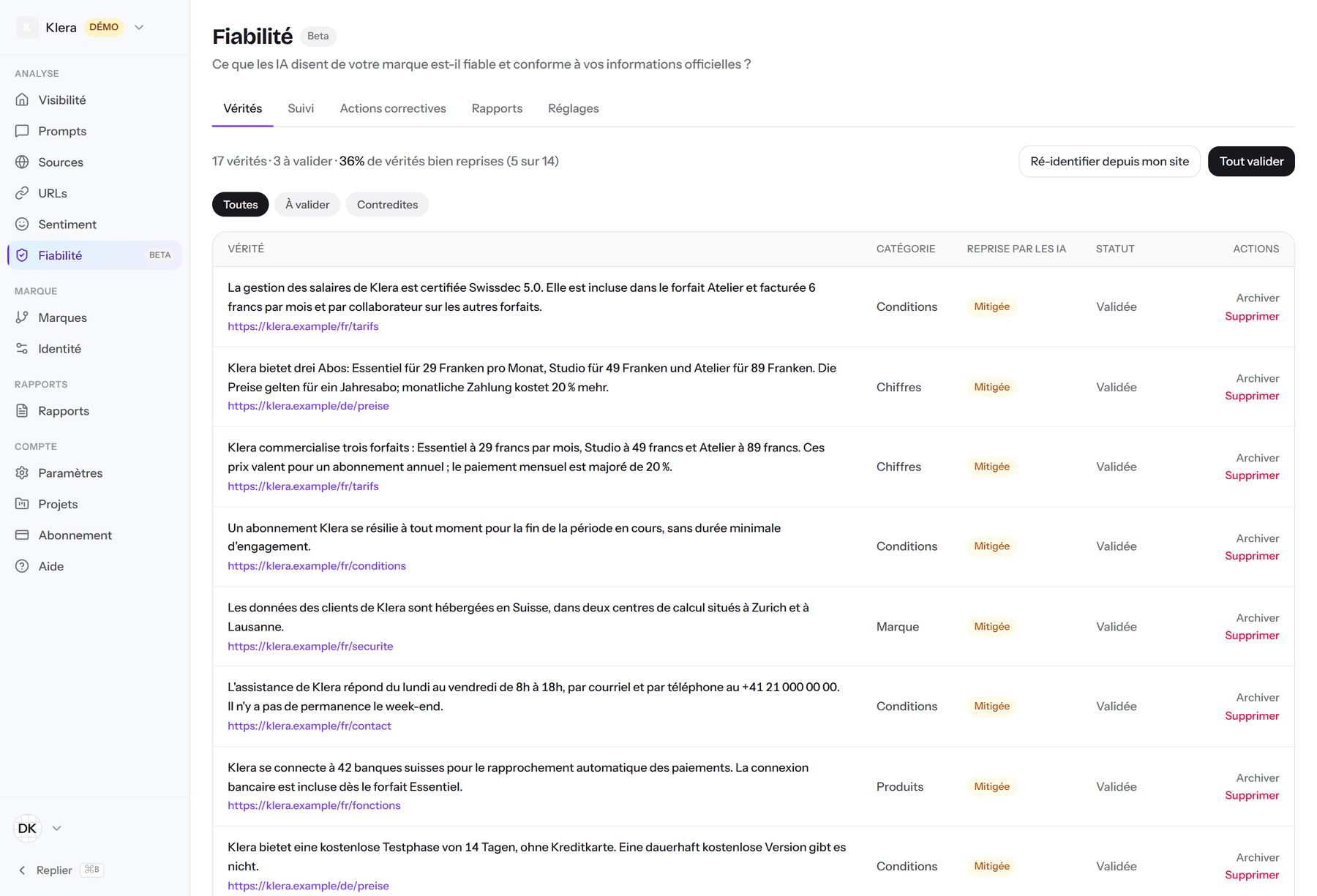
That list is yours. It keeps only what a customer acts on: a price, an opening time, a phone number, a condition. 15 well-chosen statements carry more weight than 40 gathered at random. And when your site gives two addresses, one for visits and one for post, the reference carries both: an answer citing only one is not reported to you as an error.
Repliq Reliability module. Interface in French.
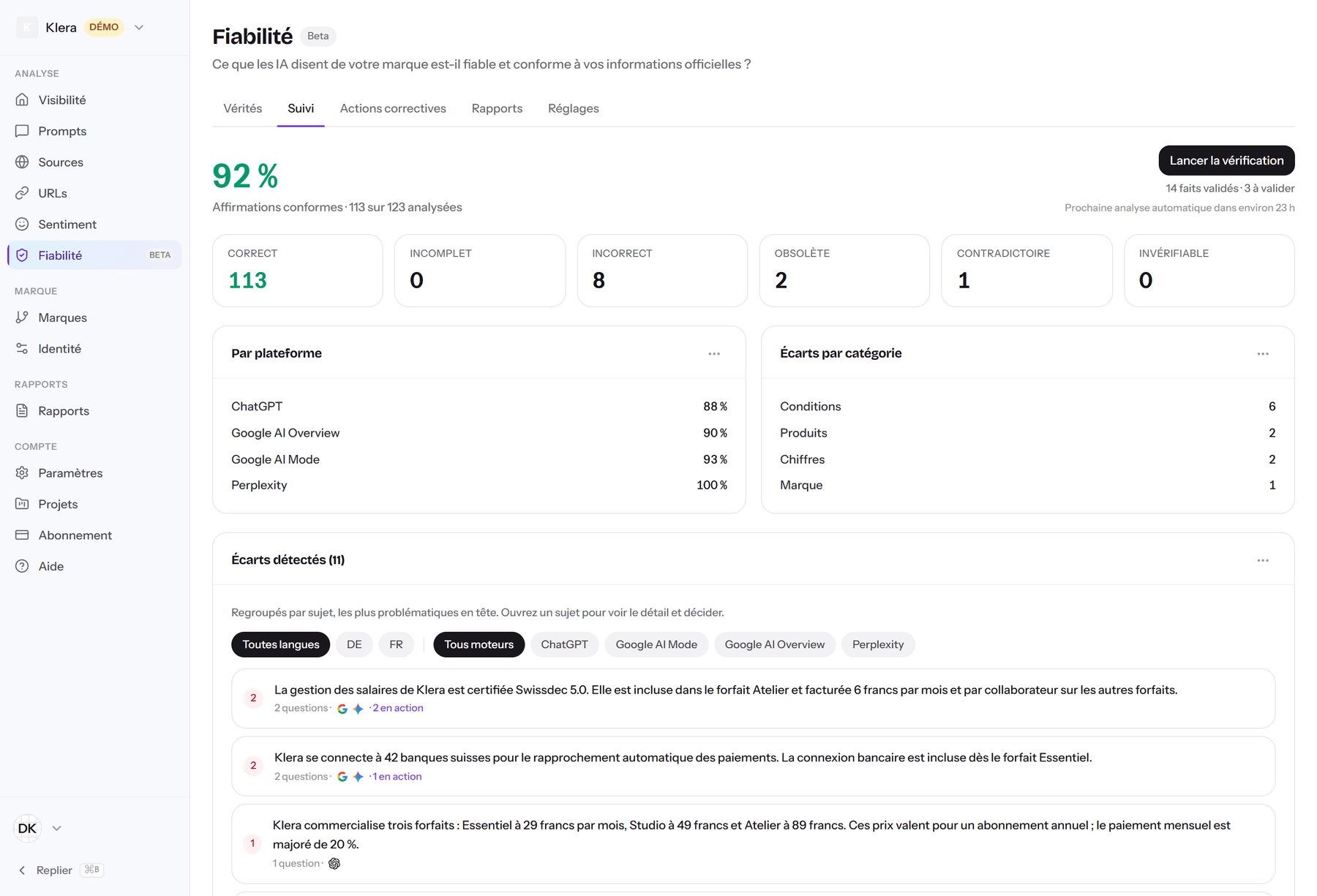
The comparison then runs on its own, every day. Every answer measured on ChatGPT, Google AI Mode, Google AI Overview and Perplexity is compared against that reference, statement by statement. You read a reliability score, the gaps grouped by subject, and for each one the third-party page the assistant cited. A statement that is accurate in French and wrong in German shows up at a glance.
Repliq Reliability module. Interface in French.
A corrected gap, on your side or a third party's, moves to observation. Repliq rechecks at every measurement and closes the gap on the day the assistant picks up the correct information, with the date. What counts is not that the page was updated, it is that the answer changed.
Tracing the page that feeds the error
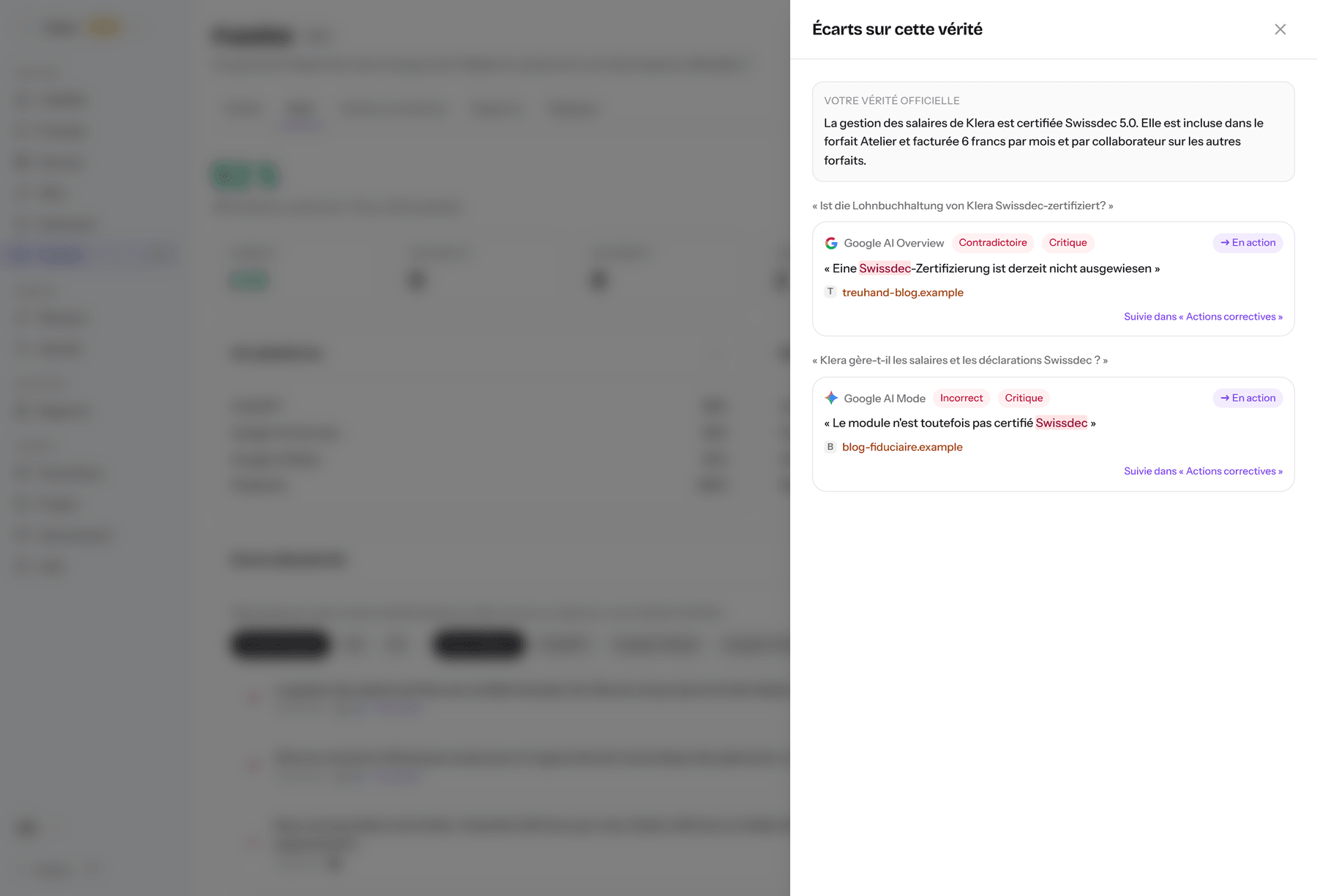
Assistants often place a citation link directly on the sentence they source. When that link exists, you hold the exact page: the one the engine read to write that statement.
More than 9 gaps in 10 trace back to an identifiable external source. Those sources are spread across dozens of different domains. So this is not three large faulty sites, but a dust of pages, each contributing a little.
Repliq Reliability module. Interface in French.
That traceability changes the nature of the work. Without it, a gap is a fact of life. With it, it is a page to have corrected, often through an email to a publisher who has no reason to refuse.
A legitimate source can also contradict another. A municipal administration and a hospital in the same town can publish two different numbers for the same emergency line. Neither is wrong. The assistant picks one, and the person calling still gets it wrong. That kind of case is settled between the two institutions.
What you can check this week
Ask an assistant three questions your customers actually ask. Avoid "what do you think of my company", which invites a vague answer. Ask instead what you sell and at what price, where you are found, how an appointment is booked.
Compare each sentence of the answer against your own page, word for word. Then open the sources cited below the answer and see where the wrong part comes from.
If everything is accurate, the subject does not concern you yet. If a figure is wrong, you will see straight away that it did not come from you.
This holds as much for a ten-person company as for a university hospital. The difference lies in how many third-party pages talk about you, not in your size.
To follow this continuously rather than once, the Reliability feature does the work every day, across the four assistants, and alerts you when a gap appears.
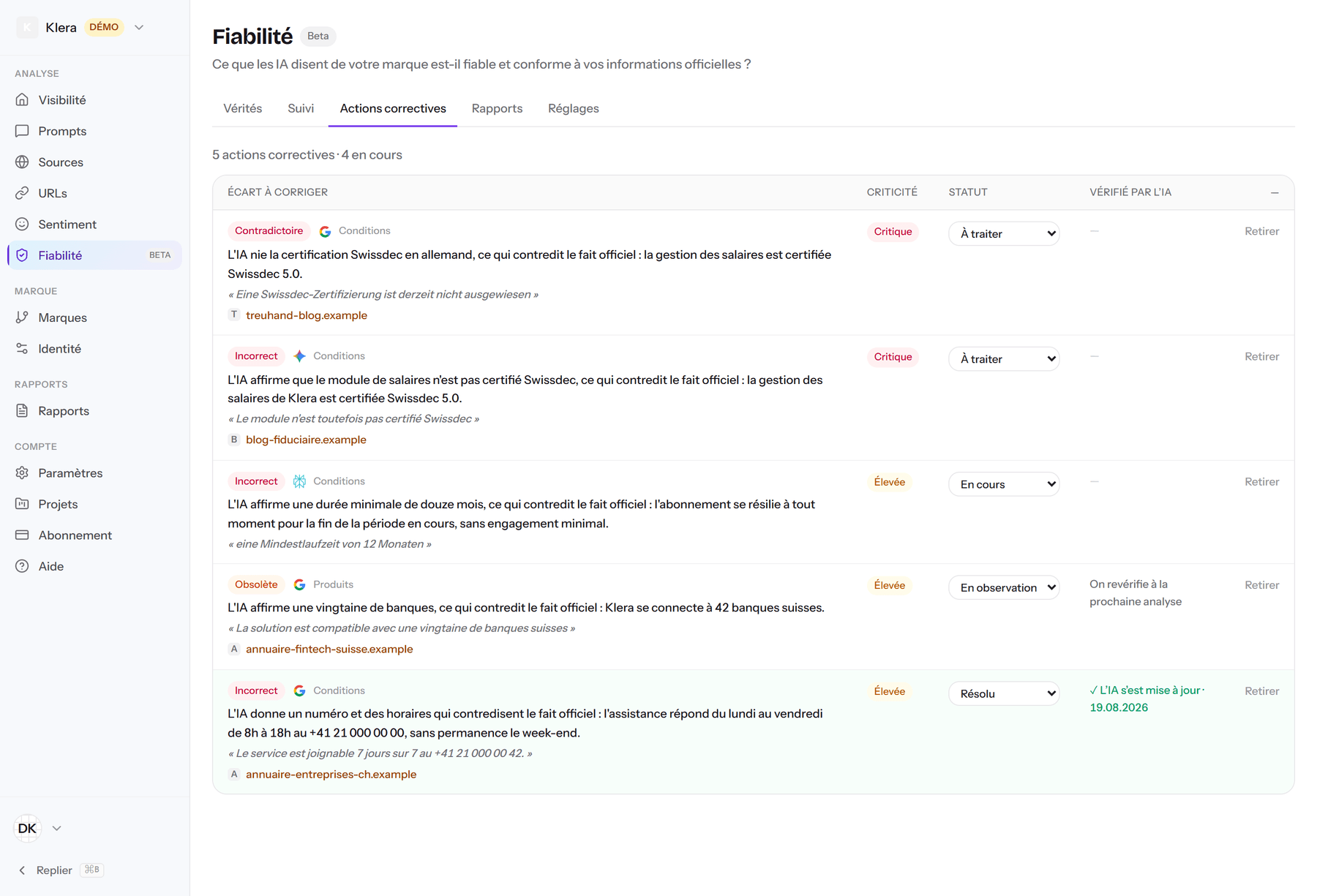
Repliq Reliability module. Interface in French.
The proportions cited are measured across 22 Swiss brands and institutions tracked by Repliq, over 700,000 citations. The third-party share ranges from 69 % to 100 % depending on the organisation; the median is 92 %. Per-organisation rates are not published: that data belongs to the brands tracked.
Frequently Asked Questions
Why does an AI get things wrong when my website is up to date?
Because it does not read only your website. Across the answers analysed, 90 % of cited sources are third-party pages: comparison sites, professional directories, press articles, forums. Those pages age at their own pace and nobody keeps them current on your behalf. Fixing your own site will therefore not always be enough.
How does Repliq's Reliability feature work?
In three steps. Repliq reads your website and proposes a short list of official statements, which you confirm or correct. Every answer measured on ChatGPT, Google AI Mode, Google AI Overview and Perplexity is then compared against that list, statement by statement. Each gap arrives with the third-party page the assistant cited to write it.
How long does it take to set up?
Reading the website is automatic and takes a few minutes. Confirming the official statements takes about an hour the first time, because it deserves a real review. After that the monitoring runs daily and asks nothing more.
Do I need to write hundreds of facts to check?
No, and it would be counterproductive. 15 to 20 well-chosen statements are enough: the ones a customer acts on, such as a price, an opening time, a phone number or a condition. Each one carries the link to the page that proves it and the exact sentence found there.
How do I know which page misled the assistant?
Assistants often place a citation link directly on the sentence they source. When that link exists, you reach the exact page and a correction request becomes possible. When it does not, the information probably comes from the model's memory, and writing to a publisher would change nothing. Telling the two apart saves time.
What happens once the error is identified?
If the gap comes from a third-party page, an email to the publisher is usually enough: nobody benefits from publishing false information about you. If the gap comes from one of your own pages, the fix is immediate. Either way, Repliq rechecks at every measurement and gives you the date the assistant picked up the correct information.
Does this also concern public institutions?
Yes, and often more so. A public administration spreads its information across the municipality, the canton and sometimes a partner establishment. Assistants blend those levels, and the person asking ends up with the wrong contact. Across the organisations tracked, public institutions show markedly more gaps than commercial companies.
Which assistants are covered?
ChatGPT, Google AI Mode, Google AI Overview and Perplexity, in your customers' language. Monitoring covers the engines included in your subscription, add-ons included.
Follow what AI answers in Switzerland
New studies, sector analyses and measured cases, with every publication. Repliq tracks ChatGPT, Gemini, Google AI Mode, Perplexity and Grok.
No sales follow-up. Unsubscribe in one click.
Measure your AI visibility
Discover how ChatGPT, Google AI Mode and Google AI Overview talk about your brand. One-off audit or continuous monitoring, your call.
Discover the AI visibility auditRelated Articles
From search to recommendation: who answers for your brand in AI?
AI is turning information search into a direct recommendation where users expect arbitration. Our study of 8,800 citations shows that leading Swiss brands today control only 5 to 12% of their own narrative inside these interfaces. This guide unpacks how challengers like rappn and Magic Heidi break through with structured content, and how established brands can reclaim the conversation by becoming reference sources for the algorithms.
The 3 Essential GEO KPIs: Visibility, Sentiment, Recommendation
GEO is measured with 3 essential KPIs: Visibility (are you mentioned?), Sentiment (how are you described?), and Recommendation (are you suggested as a solution?). These metrics replace traditional SEO rankings for evaluating your presence on ChatGPT, Gemini, and Perplexity.
Google AI Overview: when it actually appears
AI Overview is the text Google displays above the links, written by the AI at the moment of the search. Across more than 2,800 questions asked in French-speaking Switzerland, it appears in three cases out of four. It almost always answers “how much does it cost”, almost never “where to buy”: when it is time to choose where to buy, your customers get the links back. The sources it cites are not Google's top results, and they change completely from one national language to another.