Claim your business in ChatGPT (Business Hub)

Since 10 November 2026, OpenAI has let businesses claim their listing in ChatGPT, in beta, under the name Businesses in ChatGPT. From the Business Hub, a verified business updates its information, adds a catalogue with prices and availability, and sees how many times ChatGPT mentioned it, how many times its listing was viewed and how many clicks went to its website. OpenAI opens the process to any eligible business located in a country where ChatGPT is available, Switzerland included; on launch day, access from Switzerland went through a waitlist. The Business Agent, which answers on the business's behalf in ChatGPT, is limited for now to e-commerce and online services in the United States. Everything is free during the beta. According to OpenAI, claiming a listing should not change how often a business appears: recommendations are still drawn from what the web says about it.
Table of Contents· 7 sections▾
A guide kept up to date as the rollout continues. Last updated: 10 November 2026.
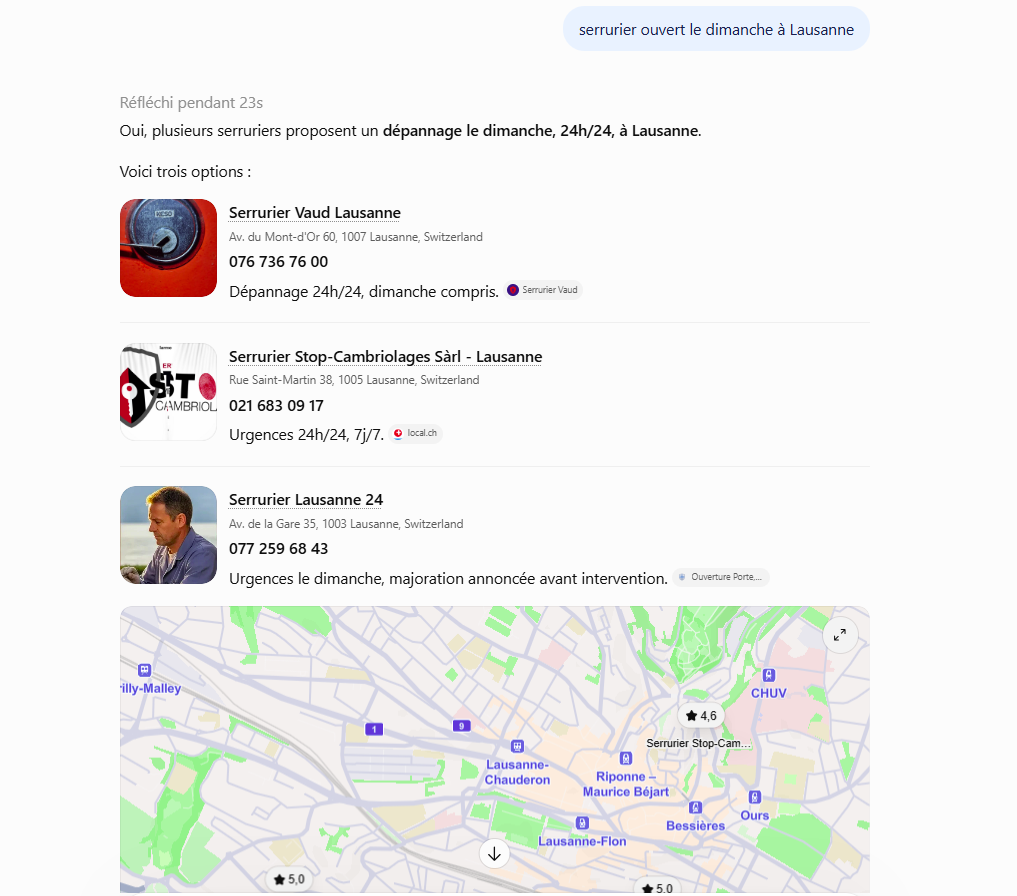
Ask ChatGPT for a locksmith open on Sunday in Lausanne. The answer often comes with a few listings: a name, an address, a phone number. None of them was written by the business concerned. Until now, ChatGPT pieced this information together from what the web said about the business, and nobody could correct it at the source.
On 10 November 2026, OpenAI opened Businesses in ChatGPT in beta. A business can now claim its listing, have it verified, keep it up to date and see how often ChatGPT shows it. OpenAI opens the process to any eligible business located in a country where ChatGPT is available, which includes Switzerland. On launch day, from Switzerland, the Business Hub offered a waitlist.
ChatGPT screenshot, November 2026.
For a Swiss SME, there is no rush. Signing up costs nothing, and a few steps can be prepared right now. Above all, the listing says a lot about how ChatGPT intends to treat businesses, and about what will remain, or not, of search optimisation as we know it.
What OpenAI launched on 10 November
OpenAI says it reaches 1.2 billion people every week. It now offers businesses two products to reach them. The Business Hub is where a business claims its listing, updates it and reads its figures. The Business Agent lets the business answer the questions people ask about it in ChatGPT itself.
| Feature | What it does | For a Swiss business on 10 November 2026 |
|---|---|---|
| Verified listing | Claim your business, have it verified, get the blue badge | Open in countries where ChatGPT is available; waitlist observed from Switzerland |
| Information and catalogue | Contact details, description, product feeds with prices and availability | Comes with the listing |
| Insights | Mentions, listing views, clicks to the website, conversation topics | Comes with the listing |
| Business Agent | Answers on the business's behalf, in a separate conversation | Limited to e-commerce and online services in the United States |
| Sponsored agent | The same agent, promoted through a ChatGPT ad | Not announced for Switzerland |
Everything is free during the beta, OpenAI told Digiday. Only the sponsored agent is paid, since it runs through advertising.
This is not OpenAI's first step towards commerce. Buying directly inside ChatGPT, paid for through a commission, was stopped in March, TechCrunch points out. This time, OpenAI says it is starting with "the foundations: accurate business information, useful insights, and conversations that help people make informed decisions".
The features, one by one
The verified listing
When a business appears in an answer, the user can click to open its ChatGPT listing. It shows the business's products, its information, a button to its website and, if there is one, a button to chat with its agent. A claimed and verified listing carries a blue badge.
Verification depends on the case. Benji Shomair, who leads monetisation at OpenAI, talks about "multiple verification methods that we use for different types of business in different markets". A Shopify merchant can connect its store, from the Business Hub or from the Shopify admin. OpenAI Enterprise customers and advertisers go through their contact at OpenAI.
For the first time, a business has a direct channel to tell ChatGPT who it is. Until now, the only way to correct a piece of information was to change what the web said, and then wait.
Information and catalogue
Once verified, the business updates its key information and adds product feeds, with prices and availability. OpenAI says it wants to help people explore products and services "using the most accurate and up-to-date details". Eligible products from Shopify merchants are already in ChatGPT, through Shopify's catalogue.
For an online retailer, the product feed becomes one more way in, like the one it may already maintain for Google Shopping. What counts there is ordinary, and it still decides a lot: prices in Swiss francs, real stock, product names your customers recognise.
OpenAI publishes the format of this catalogue in its merchant documentation. Nine fields are required for every product.
| Field | What it holds |
|---|---|
item_id | The product's unique identifier |
title | The product name |
description | Its description |
url | The product page on your site |
brand | The brand |
seller_name | The seller's name, that is, your shop |
image_url | The main image |
availability | Stock status: in_stock, out_of_stock, pre_order, backorder or unknown |
price | The price, followed by the three-letter currency code, for example 79.99 USD |
A product sold in several sizes or colours adds three fields: group_id, listing_has_variations and variant_dict.
One point matters for Switzerland. As of 10 November, this format targets the United States. Other countries open only once OpenAI has confirmed the integration, with its countries and currencies, and the Swiss franc is not mentioned. The page does not mention the Business Hub either: nothing yet says that its catalogue follows exactly this format.
The dashboard
The Business Hub shows the number of mentions, listing views and clicks to the website. It also shows discovery topics, meaning the subjects that come up in conversations where the business's website is cited.
The word "mention" does not mean what you might think. For a local business, OpenAI counts a mention when ChatGPT shows a result for its premises. For an online business, when ChatGPT links to its website. A spokesperson made this clear to Digiday: naming the brand is not enough. The clicks are those that left from ChatGPT's links, not full visits or purchases.
A business can therefore be recommended by name, with no listing and no link, and see nothing in this dashboard. The reverse also happens: a link to your website, in the middle of a list of sources, counts as a mention without the answer recommending you.
The dashboard only shows your own figures. Share of voice against competitors is not part of the beta. Data only appears above a certain volume of conversations, to protect privacy. For an SME that receives a few dozen enquiries a month, that will probably be the usual situation.
The Business Agent
Once its listing is claimed, an eligible business can build, test and launch its agent. A user who opens the listing can then start a conversation with the business: compare two products, ask which one suits their needs. The agent answers from the information and catalogue the business has provided.
OpenAI insists on the separation. The conversation with the agent is labelled as such, distinct from the original conversation and from ChatGPT's independent answers. The business cannot plug in its own chatbot. When the buyer is ready, the agent sends them to the brand's website, which completes the sale itself.
The agent is open to e-commerce and online service businesses based in the United States, within a list of categories published by OpenAI.
The sponsored agent
A business can also sponsor its agent and make it the destination of its ChatGPT ads. These placements are labelled and kept apart from the answers. Benji Shomair sums up the logic: "Think of the business agent as the organic experience... The sponsored agent is the paid experience, but the agent that sits behind it should be the same."
ChatGPT ads have been on sale in Switzerland since 31 August. Nothing suggests for now that their "agent" version is open here.
Which Swiss businesses are concerned
All of them, in principle, since the listing is open in countries where ChatGPT is available. In practice, the benefit depends on the trade.
| Type of business | For example | What the listing brings first |
|---|---|---|
| Local shop or tradesperson | A bakery in Fribourg, a garage in Sion, a locksmith in Lausanne | Correct opening hours, address and phone number in the listings ChatGPT already shows |
| Practice or local service | A fiduciary, a dental practice, a property management agency | An accurate description of the services and the area covered |
| Online shop | A Shopify store delivering across Switzerland | The catalogue with prices in Swiss francs and stock, and the simplest verification |
| Online service | Software, a booking platform | The dashboard to start with, the agent when it comes to Switzerland |
Switzerland has to be written down. When a question in French does not name Switzerland, ChatGPT often lands on French websites first, as we measured in how ChatGPT talks about a company. A listing and a website that state the canton, the municipality, prices in Swiss francs and Swiss VAT help the assistant place you on the right side of the border.
One business, often two languages. A business in Biel/Bienne or Fribourg serves its customers in French and German, a Ticino business in Italian and German. Write your information in every language you work in, with the same facts. OpenAI has said nothing about listings in several languages: in the meantime, your website carries the versions.
The name your customers use. The commercial register gives the legal name, with its legal form: "Dupont Serrurerie Sàrl". Your customers say "Dupont" or "the Dupont locksmith". Give both, on the listing as on your website, and keep your UID number (CHE-…) close at hand: it identifies the business without ambiguity.
How to claim your business from Switzerland, step by step
1. Look at what ChatGPT already shows about you. Ask ChatGPT the questions your customers really ask: your trade and your town, then the name of your business. Note what is wrong or missing in the listings and in the text. That is the list of what the listing will need to correct.
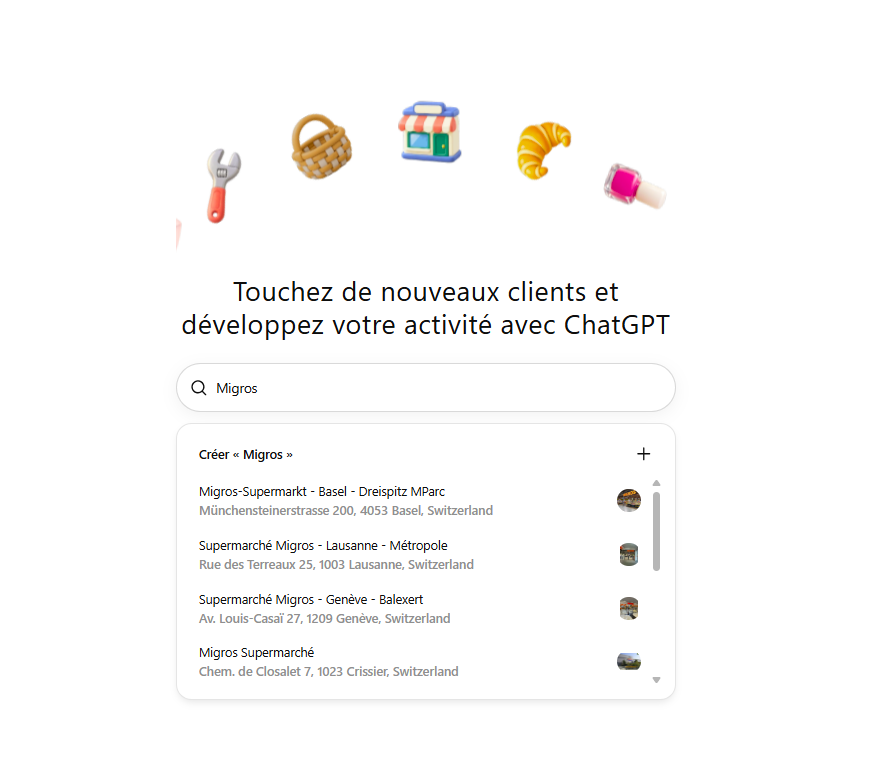
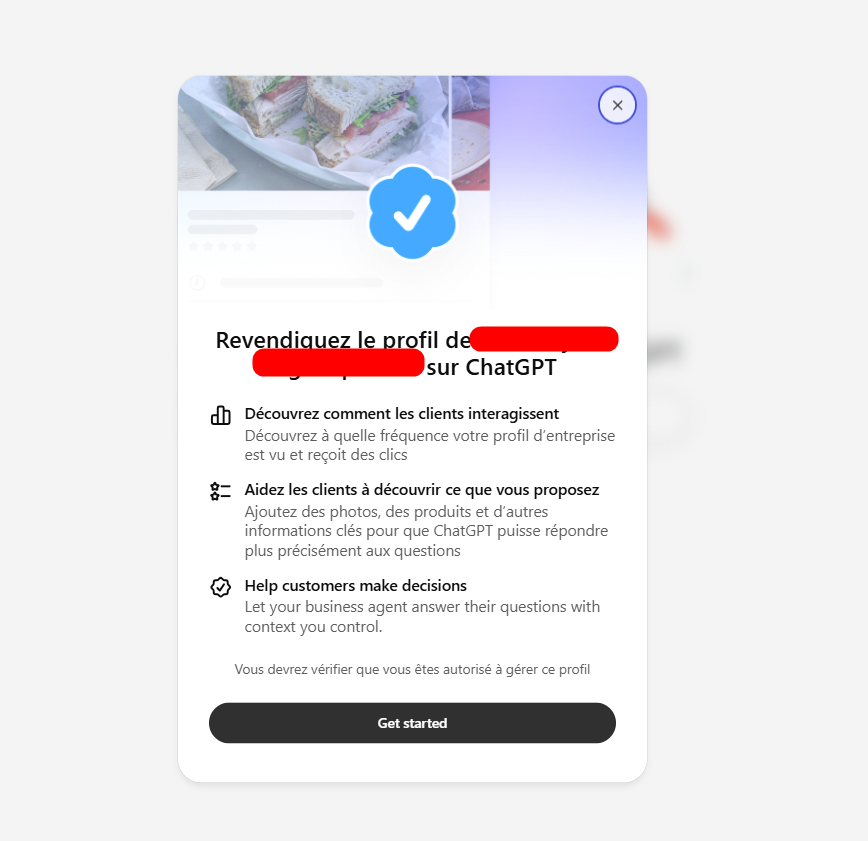
2. Open the Business Hub. Everything starts at chatgpt.com/business-hub. You start by searching for your business: ChatGPT suggests the locations it already knows, each with its address, or offers to create a listing. It then asks you to verify that you are authorised to manage the profile. From Switzerland, as of 10 November, the « Get started » button then leads to a waitlist: sign up. Use an email address on the business's domain rather than a personal one. Verification will look at your right to represent the business, so you may as well start from an address that shows it.
ChatGPT screenshot, November 2026.
ChatGPT screenshot, November 2026.
3. Prepare your proof. If your shop runs on Shopify, connecting the store is the simplest route. For other businesses, OpenAI has not detailed its methods, which vary by type of business and by country. Keep at hand your commercial register extract, which Zefix finds in a few seconds, and access to your website.
4. Write your information once, properly. Exact legal name, address, opening hours, area covered, services, prices in Swiss francs where you publish them. This text will feed the listing, but it first has to be right on your website. A listing that contradicts your home page leaves the assistant to choose between the two.
5. Prepare the catalogue, if you sell online. Start from the feed you may already maintain for Google Shopping or a comparison site. Check that it carries prices in Swiss francs and real stock. Most of the nine required fields already have an equivalent there under another name; seller_name usually has to be added.
If your business is already an OpenAI Enterprise customer or buys ChatGPT ads, ask your contact at OpenAI: they can claim the listing with you, without going through the waitlist.
What it changes for GEO and SEO
This launch concerns us directly, and we are following it closely. Repliq already measures, from the outside and across several assistants, part of what OpenAI's dashboard will count. The aim is to bring the two together: integrate this new data into our analyses and correlate it with our own readings, as soon as the first figures are available.
A recommendation cannot be claimed
Claiming your listing does not buy a place in the answers. Benji Shomair told Digiday on launch day that the product has to "maintain objectivity", and that claiming a business "should not have an impact on how frequently it appears". He adds a nuance. Clearer information could help ChatGPT show the business in more relevant conversations, since it will know better what the business offers.
The listing therefore helps the assistant understand you. It does not push it to recommend you. What gets a business recommended is still what ChatGPT finds when it searches the web at the moment it answers: your website, comparison sites, the press, directories, reviews. We described this mechanism in how ChatGPT talks about a company.
There is also less room than before. On the local questions we track in Switzerland, ChatGPT showed about a dozen listings per answer at the end of September. In early October, on the same questions, it showed only three or four, for businesses the answer already named. Being picked in the text comes before the listing. That is the work of GEO, and the listing does not replace it.
Accuracy, on the other hand, becomes correctable
The most concrete gain lies elsewhere. Wrong opening hours, an old address, a price from 2023: until now, you had to find the website carrying the error and get it corrected. The listing gives a direct channel for facts of that kind.
It does not settle everything. An error picked up by a third-party site stays in the web ChatGPT consults, and we do not yet know whom the assistant believes when its listing and a press article contradict each other. Tracing the source of the error therefore remains useful.
An official measure, with its blind spots
The dashboard will be the first figure supplied by ChatGPT itself. On the SEO side, the equivalent would be Google Search Console, and it will probably become the figure management quotes in meetings.
It answers one question well: how many times did ChatGPT show me, and how many clicks came from it. No outside tool will do better, since only OpenAI sees its own conversations. It does not answer two others: who is recommended instead of me, and what the other assistants say. Some of your customers ask the same question to Google, Perplexity or Gemini, as the four places an SME must be found show.
Local search gains one more listing to maintain
A Swiss business already maintains its Google profile, often its entry on local.ch or search.ch, sometimes one in a trade directory. ChatGPT joins the list. The nature of the work does not change: the same facts, written the same way, everywhere. An address or opening hours that differ from one listing to another leave each engine to decide on its own.
The agent moves part of the visit
This is the deepest change, and the most uncertain one. With the agent, the conversation about your offer can take place inside ChatGPT, in your words, before any visit to your website. Visitors would arrive later in their decision, and perhaps less often. We have no data to put a number on it, and the agent is not yet open in Switzerland.
One point is already visible. The same agent serves the free version and the sponsored version. The line between what you earn and what you buy is getting thinner, as we observed for ChatGPT and Google ads.
What we don't know yet
As of 10 November 2026, several questions have no public answer:
- when the waitlist will open for Swiss businesses, and which businesses OpenAI considers "eligible";
- how a business that does not sell on Shopify gets verified;
- whether a listing is kept in one language or several, for a business serving Geneva and Zurich;
- how a chain manages its locations, which the Business Hub shows as separate listings, and whether an agency will be able to manage a client's listing;
- what weight ChatGPT gives the listing when it contradicts the rest of the web;
- over what period mentions are counted, and from what volume they are displayed;
- whether catalogues priced in Swiss francs will be accepted, and from when;
- whether the Business Hub will stay free after the beta.
We add to this guide as answers come in, and every change is dated at the bottom of the page.
My view
Join the waitlist. It costs nothing, and ChatGPT already shows listings for businesses, with or without their consent. Better that they carry your information than a directory's.
Do not expect it to affect your recommendations. OpenAI itself says the listing does not change how often a business appears, and we have no data suggesting otherwise. The listing corrects what ChatGPT shows about you. It does not decide whether it cites you.
The useful work starts before the waitlist opens, and it serves every assistant at once. Write on your website, in one place, the facts you want to see repeated: what you do, where, for whom, at what price. Repliq publishes its own on a facts page, written to be read by assistants. Then check that your Google profile and the Swiss directories you appear in say the same thing.
At Repliq, we record every day what ChatGPT, Google AI Mode, Google's AI Overview and Perplexity answer to Swiss questions, in French, German and Italian. An audit runs this check on your customers' questions, with the websites the assistants cite instead of yours.
Further reading
→ OpenAI, Introducing Businesses in ChatGPT (openai.com), the announcement of 10 November 2026
→ OpenAI, Products (developers.openai.com), the product feed specification for ChatGPT
→ Digiday, OpenAI's new business agents give brands a free way into the conversation (digiday.com), with OpenAI's clarifications on ranking and the dashboard
→ TechCrunch, OpenAI rolls out new business profiles, making ChatGPT just a little bit more like Google, 10 November 2026, on verification and the end of in-chat buying
Update log
→ 10 November 2026: launch of the Businesses in ChatGPT beta, first version of this guide.
See what AI assistants say about your businessFrequently Asked Questions
How much does a business listing in ChatGPT cost?
Nothing for now. The Business Hub and the Business Agent are free during the beta. OpenAI's head of monetisation, Benji Shomair, has not ruled out a paid model later. The sponsored version of the agent runs through ChatGPT ads, so that one is paid.
Can the business see users' conversations?
No. OpenAI writes that it shares neither users' conversations nor their exchanges with the agent with businesses. The dashboard only shows aggregated figures and the topics of the conversations where the business appears, and only above a certain volume.
When will the Business Agent come to Switzerland?
OpenAI gives no date. For now, the agent is limited to e-commerce and online service businesses based in the United States. OpenAI announces an extension to other markets and other categories, without a timetable.
Does ChatGPT now have its own equivalent of Google Business Profile?
In intent, yes: a listing the business claims, has verified and keeps up to date, with figures on views and clicks. The difference lies in ranking. On Google, a complete profile helps a business appear on the map. On ChatGPT, OpenAI says claiming a listing should not change how often a business appears.
Follow what AI answers in Switzerland
New studies, sector analyses and measured cases, with every publication. Repliq tracks ChatGPT, Gemini, Google AI Mode, Perplexity and Grok.
No sales follow-up. Unsubscribe in one click.
Measure your AI visibility
Discover how ChatGPT, Google AI Mode and Google AI Overview talk about your brand. One-off audit or continuous monitoring, your call.
Discover the AI visibility auditRelated Articles
How do ChatGPT and AI assistants cite a company?
ChatGPT and other AI assistants talk about a company in two ways. Either with what the LLM learned during training, its training data. Or with what it searches for on the web at the moment it answers, which is called grounding. On the Swiss questions Repliq tracks, fewer than one answer in ten cites no source at all: web search decides almost everything. Before answering, ChatGPT turns the question into several searches, the fan-out queries, and goes looking for the federal law, the canton, the FRC consumer association or the brand's official site. When the question says Switzerland, the sources turn Swiss. When it does not, the assistant lands on French websites first. A page that clearly states Switzerland, Swiss francs and the year therefore starts with an advantage.
The four places an SME must now be found
Your customers no longer look in the same place. Four surfaces matter today: web search, the AI assistants, video and social platforms. In our Swiss observatory, Reddit is the most cited site across all sectors, ahead of YouTube. Each surface calls for different work, and an engagement covering only one of them should say so.
When AI gets your company wrong, the error rarely comes from your site
The investment of recent years went into the website: the right information, navigation that leads the user to the right page. AI now reduces all of that to an answer a few lines long, drawing 90 % of its cited pages from third parties, from comparison sites to directories, press and forums. One answer in 14 carries at least one false statement, and every organisation we track has one in circulation. Repliq's Reliability feature compares each measured answer against your official information, then traces the page feeding the error.