How do ChatGPT and AI assistants cite a company?

ChatGPT and other AI assistants talk about a company in two ways. Either with what the LLM learned during training, its training data. Or with what it searches for on the web at the moment it answers, which is called grounding. On the Swiss questions Repliq tracks, fewer than one answer in ten cites no source at all: web search decides almost everything. Before answering, ChatGPT turns the question into several searches, the fan-out queries, and goes looking for the federal law, the canton, the FRC consumer association or the brand's official site. When the question says Switzerland, the sources turn Swiss. When it does not, the assistant lands on French websites first. A page that clearly states Switzerland, Swiss francs and the year therefore starts with an advantage.
Table of Contents· 6 sections▾
Ask ChatGPT, in French, whether Migros's Cumulus card is worth as much as Coop's Supercard. Before answering, it runs several searches on the web. One looks like this: site:migros.ch Cumulus points 500 points 5 francs 2026. Another: Migros Cumulus points value CHF 2026 Cumulus official.
You did not write "2026", "official" or "CHF". It added them itself. And it will answer you with the pages these searches find, not with its memory.
We talked about this in SEO or GEO: ranking well on Google is no longer enough to be recommended by an AI. Here, we look at how it works from the inside. How LLMs learn about your brand, how ChatGPT decides which companies to mention, and what we saw when we measured its searches on Swiss questions.
Training data: what does ChatGPT know about you before it searches?
ChatGPT, Gemini, Claude and Perplexity rest on a large language model, an LLM. That model was trained on text: articles, websites, forums. A slice of the web, frozen at a given date. That is its training data.
If your company was in that slice, the model knows it, with what people said about it at the time. If it was not, the model does not know it.
And what you publish today will only get in at the next training run, months from now. This memory matters, but you have almost no hold on it.
It matters most when the question is general. In our automotive study, the buying questions named no city and no canton: "What are the best SUVs?", "Which city car should I buy?". Between 16 August and 8 September 2026, ChatGPT answered them without citing any source in 29% of cases, 508 answers out of 1,776. On a question that broad, it sometimes answers from memory, with what its training left it about the brands.
Grounding: what does it search for when it answers?
That is the second route, and this is where most of it happens. When you ask a question, the assistant queries a search engine, reads the pages it finds, and answers from them. This is called grounding, or RAG, for retrieval-augmented generation. The idea was described as early as 2020 in a research paper (Lewis et al.). It is what consumer assistants do today.
This mechanism moves all the time. A page published this morning can be cited this afternoon.
We checked it on the Swiss questions our observatory tracks. Answers that cite no source are rare, whatever the engine.
| Engine | Answers with no source at all |
|---|---|
| ChatGPT | 2.3% |
| Google's AI Overview | 3.0% |
| Google AI Mode | 8.8% |
| Perplexity | 0% |
Answers recorded between 8 September and 8 October 2026, on the questions of ten Swiss brands in the observatory: banking, health insurance, retail, telecoms, transport, real estate, travel, education, watchmaking.
On these precise questions, which name a canton, a city or a Swiss service, the gap with the automotive study is clear. More than nine answers in ten rest on pages found in the moment. That is good news for you. What the AI says about your company depends mostly on what is published and findable today. One caveat all the same: an answer with no source may also come from a link we could not capture. These percentages are therefore ceilings.
Fan-out queries: why does one question become several searches?
The assistant does not run one search, it runs several. OpenAI says so in its documentation: ChatGPT generally rewrites the question into one or more targeted searches, which it sends to engines such as Bing (OpenAI). Google describes the same thing for AI Overviews and AI Mode. They can run "multiple related searches" across subtopics (Google). These searches are called fan-out queries.
Here is what ChatGPT searched for on 1 October 2026, on questions from our observatory (asked in French).
| Question asked | One of the searches ChatGPT ran |
|---|---|
| What recourse do I have after buying a counterfeit watch in Switzerland? | site:fedlex.admin.ch Code obligations garantie défaut vente art 197 201 Suisse |
| How do I get a refund for a faulty product bought in a Swiss supermarket? | Fédération romande consommateurs produit défectueux remboursement garantie Suisse supermarché |
| What are the alternatives to Salt for a mobile plan in French-speaking Switzerland? | site:wingo.ch mobile abonnements Suisse 2026 |
| What are my rights if my bank decides to close my account in Switzerland? | Suisse clôture compte bancaire par banque droits client délai résiliation contrat FINMA ombudsman banque |
| Best health insurance for a student in Lausanne in 2026. | assurance maladie étudiant Lausanne 2026 comparatif primes canton Vaud |
| How much does a two-week package holiday to Thailand from Geneva cost? | voyage organisé Thaïlande 14 jours départ Genève prix Suisse 2026 |
Look at where it goes. The federal law on Fedlex, the Fédération romande des consommateurs, the banking ombudsman, the canton of Vaud, the operator's website. When the question is Swiss, the assistant looks for Swiss institutions, official texts and Swiss players. For a company, these sources are neighbours worth knowing. They are the pages that will be read next to yours.
Across the whole set, we recorded 1,136 searches run by ChatGPT between July and October 2026, on questions asked in French.
It adds the year. In 30% of searches, ChatGPT writes "2026" when the question mentioned no date. A page with no date, or dated 2023, is less likely to come up.
It adds Switzerland. OpenAI passes the user's approximate location on to the engines. When the question did not mention Switzerland, ChatGPT added it in about half of the searches. The sample is small, 104 searches, but the example speaks for itself. "Does Ebookers offer the best prices for low-cost flights?", asked in French, becomes ebookers low cost flights comparison Switzerland.
It switches to English. One search in ten goes out in English, even though the conversation was in French. "Is Proton Mail worth leaving Gmail for in 2026?", asked in French, gives Proton Mail vs Gmail 2026 features privacy. It then reads English-language sources, and answers you in French with them.
It goes for official websites. For Cumulus, it searches directly on migros.ch. Google does the same: on the same question, the AI Overview relies on the Migros and Supercard pages.
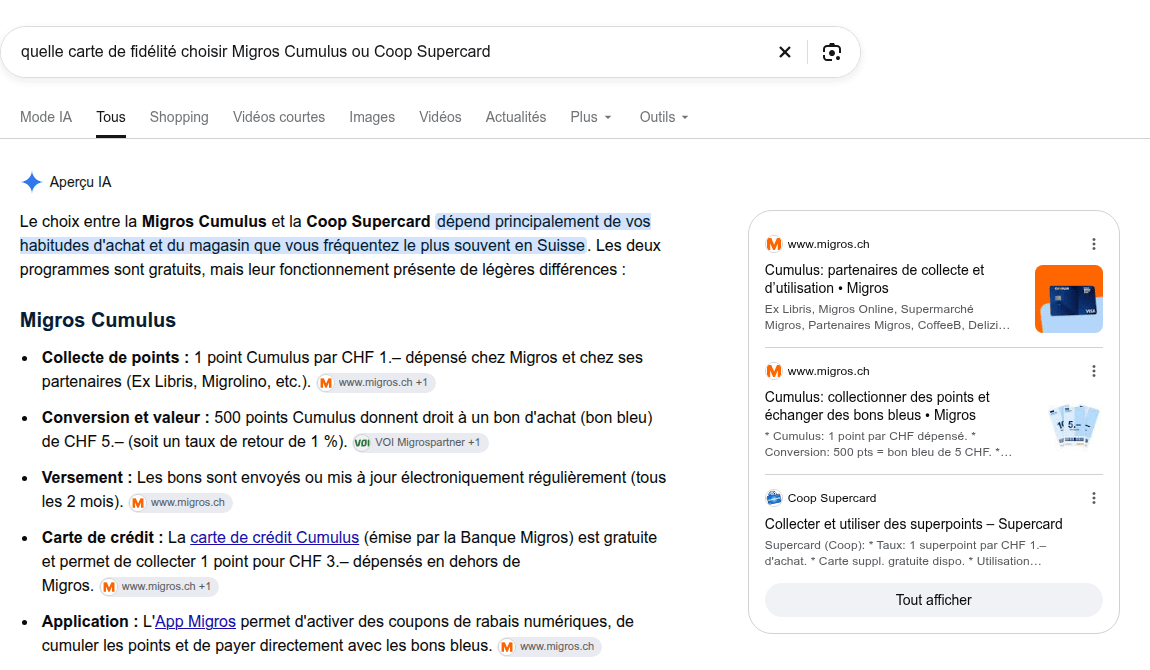
Google screenshot, October 2026.
It checks prices to the cent. Most of the time, ChatGPT makes do with one or two searches: half of the answers we recorded have only one. On a comparison, it can go much further. On 15 September 2026, "Salt Home vs Swisscom Internet, comparison 2026." triggered fifteen searches. Here are some of them:
Salt Home Internet Suisse prix 2026 Salt Home Fibre 10 Gbit/s
Swisscom blue Internet prix 2026 Suisse 10 Gbit/s
site:salt.ch "49.95" "Salt Home" 2026
site:swisscom.ch "49.90" "blue Internet L" "2026" fibre
site:salt.ch/fr/internet-tv/home-plus "CHF 59.95" "Home+" 2026
site:swisscom.ch/fr/clients-prives "blue TV S" "39.90" 2026
Swisscom fibre coverage households Switzerland 2026 FTTH 10 Gbit/s
nPerf 2025 fixed internet Switzerland Salt Swisscom 2026
The quotation marks are not there for decoration. They ask the engine for pages that contain exactly "49.95" or "CHF 59.95". The assistant is checking a precise price, on the operator's page. A price shown in an image, or one that is out of date, does not pass this check.
So your page does not answer a question. It answers the searches the assistant builds from that question. And those searches talk about Switzerland, francs, the year, what is "official". These are words a Swiss page can write in black and white.
When the question says Switzerland, the sources turn Swiss
The language of the question already changes the sources. Our automotive study asked exactly the same question in the three national languages. Here is how ChatGPT answered "What are the best SUVs?", over four rounds of measurement between 16 August and 8 September 2026.
| Language of the question | Sites cited | Most cited | Brand cited first |
|---|---|---|---|
| French | 45% French, 5% Swiss | quechoisir.org, largus.fr | Toyota |
| German | 72% German, 4% Swiss | autobild.de, adac.de | Volkswagen |
| Italian | 50% Swiss, 19% German | it.comparis.ch, topten.ch | Skoda |
Same question, three presses, three brands in the lead. In French, the assistant reads Que Choisir and L'Argus. In German, Auto Bild and the ADAC. Italian is the exception, with Comparis in Italian and Topten. Swiss content in Italian exists, and the assistant finds it.
Writing Switzerland into the question changes everything too. Compare two searches made from Switzerland, in English, on 8 October 2026.
The first does not mention Switzerland: "which robot vacuum to buy for an apartment". The AI Overview recommends the Roomba Mini Combo at CHF 229.00, via iRobot Schweiz. But its sources are YouTube videos and a Google listing, not Swiss editorial sites.
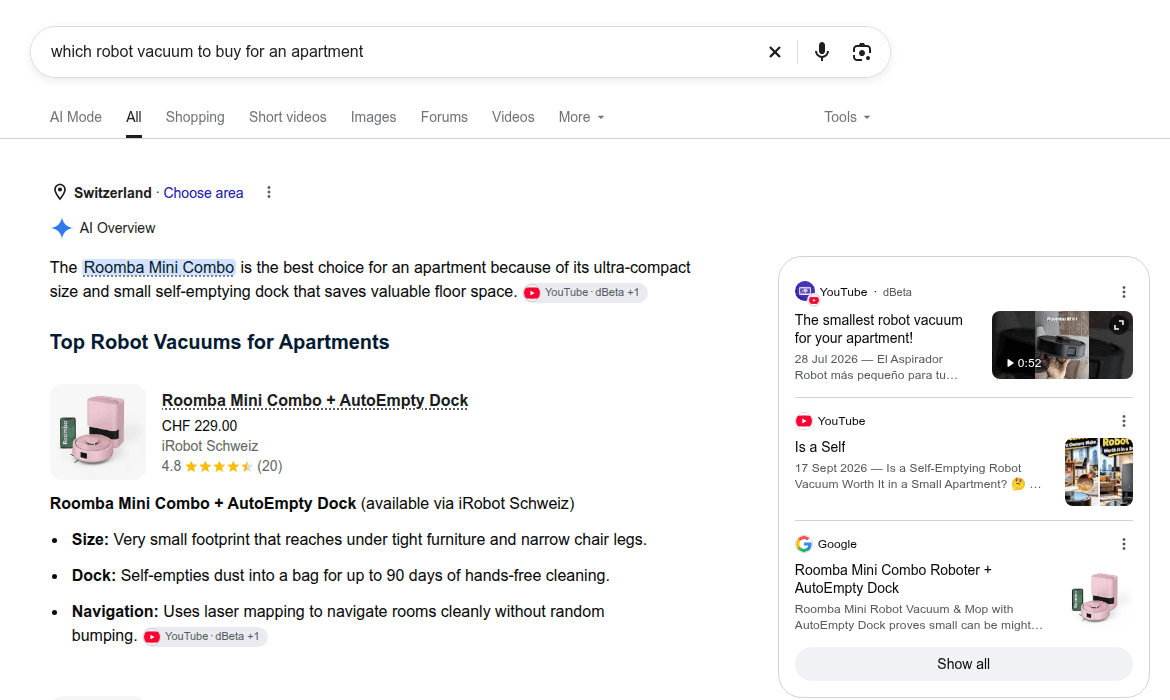
Google screenshot, October 2026.
The second names Lausanne: "best health insurance for students in Lausanne". This time, the AI Overview points to Swisscare, Assurance Genevoise and SWICA. All three are Swiss.
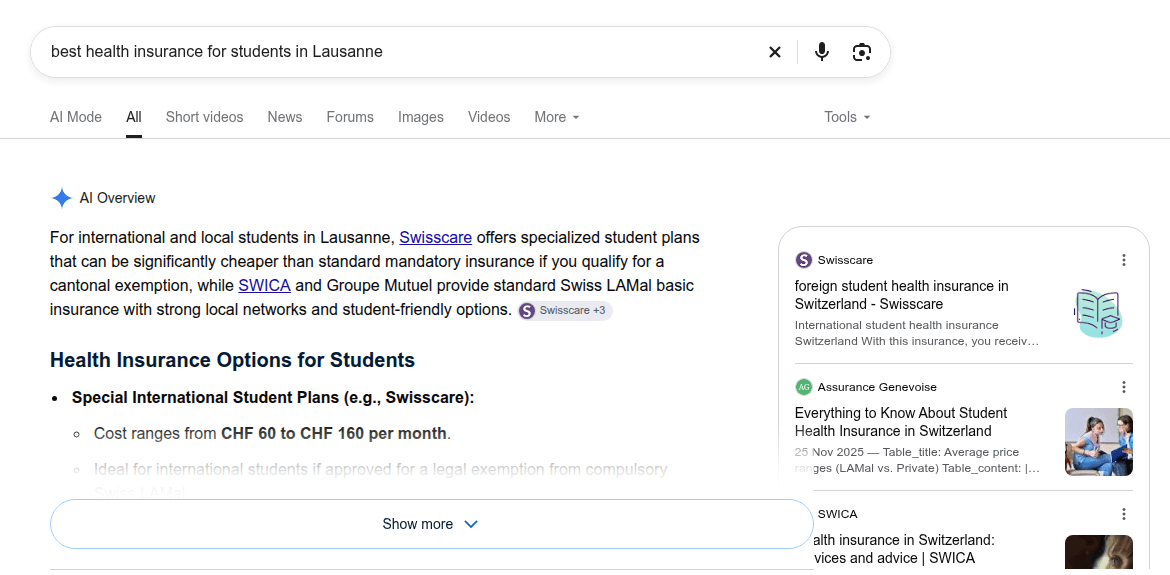
Google screenshot, October 2026.
This is not a fluke of two screenshots. The figures show the same thing.
On buying questions that do not name Switzerland, those in our automotive study (in French), 51% of the sites cited in French are aimed first at the French market. Sites built for Switzerland stay between 13% and 16%. The same goes for German with sites from Germany, and for Italian with sites from Italy.
On the questions in our observatory for French-speaking Switzerland, which nearly all mention Switzerland, a canton or a city, the picture reverses.
| Engine | Citations to a .ch website | to a .fr website |
|---|---|---|
| ChatGPT | 73% | 1% |
| Google AI Mode | 75% | 1% |
| Google's AI Overview | 68% | 3% |
| Perplexity | 65% | 8% |
Citations recorded between 8 September and 8 October 2026, on the questions of ten Swiss brands in the observatory. The rest goes mostly to .com and .org websites.
The two studies do not ask the same questions, and they do not classify sites the same way. So we do not compare the figures one by one. But the direction is clear. The more Switzerland is written, in the question or in the rewritten search, the more Swiss the sources.
And these Swiss sources differ from one sector to the next. Here are the ones the assistants cite most, sector by sector, in the latest edition of the observatory.
| Sector | The five most cited sites |
|---|---|
| Online banking and finance | moneyland.ch, mustachianpost.com, thepoorswiss.com, ubs.com, raiffeisen.ch |
| Health insurance | fr.comparis.ch, compassurance.ch, groupemutuel.ch, axa.ch, priminfo.admin.ch |
| Telecommunications | reddit.com, youtube.com, fr.comparis.ch, moneyland.ch, swisscom.ch |
| Higher education | orientation.ch, unil.ch, epfl.ch, 24heures.ch, reddit.com |
| Public transport | sbb.ch, mobility.ch, tpg.ch, publibike.ch, frimobil.ch |
| Travel and tourism | kuoni.ch, abouttravel.ch, valais.ch, loisirs.ch, dertour-suisse.com |
| Real estate | realadvisor.ch, immoscout24.ch, homegate.ch, reddit.com, fr.comparis.ch |
| Retail | rappn.ch, reddit.com, migros.ch, coop.ch, blick.ch |
| Restaurants | fr.tripadvisor.ch, instagram.com, gaultmillau.ch, eisenbahn-zell.ch, facebook.com |
| Luxury watchmaking | youtube.com, chrono24.fr, dreyfussmayet.com, forumamontres.forumactif.com, fhs.swiss |
Swiss Atlas, Repliq observatory, October 2026 edition. Ten Swiss-French verticals, questions asked daily.
The assistant adds Switzerland or francs to part of its searches by itself. So a page that writes them in black and white stands a better chance than the best-ranked French page.
Why isn't ranking first on Google enough?
Because each assistant searches a different index. ChatGPT goes through Bing, among others. AI Overviews and AI Mode use Google. Perplexity has its own index. Claude reportedly goes through Brave, according to several observers, although Anthropic has not confirmed it (TechCrunch).
Nor do they read the same number of pages. On the questions in our automotive study, the average number of sources per answer varies ninefold.
| Engine | Sources per answer, on average |
|---|---|
| Perplexity | 18.1 |
| Google AI Mode | 6.5 |
| ChatGPT | 4.7 |
| Gemini | 2.9 |
| Grok | 2.0 |
Repliq automotive study, 1,776 answers per engine, from 16 August to 8 September 2026.
At Perplexity, an answer rests on about twenty pages: there are many places to take, but each one weighs little. At Grok or Gemini, two or three pages make the answer: being among them changes everything.
You do not need to work on each engine separately. But none of them should be blocked by mistake. A robots.txt file that is too strict, or a page that only shows its text with JavaScript, and some assistants stop reading you.
At OpenAI, the two mechanisms in this article even have a crawler each (OpenAI). GPTBot collects content for model training. OAI-SearchBot is what makes websites appear in ChatGPT's search answers. You can refuse the first without losing the second. Blocking OAI-SearchBot, on the other hand, takes you out of the answers.
# Stay in ChatGPT's answers without feeding model training
User-agent: GPTBot
Disallow: /

User-agent: OAI-SearchBot
Allow: /
Disallow: /espace-client/
One technical detail costs a lot here. A crawler only applies the group that names it, and ignores the rest of the file. The rules written under User-agent: *, your private pages for example, must therefore be copied into each named group. That is the Disallow: /espace-client/ line in the example. We made this mistake on our own site, before fixing it.
What can you do with this?
→ look at the searches, not just the questions. The words that come back, the year, "price", "official", "reviews", tell you what your pages need to contain
→ write Switzerland in black and white: prices in francs, cantons, local conditions, references to Swiss law where they matter. What goes without saying for a client in French-speaking Switzerland has to be written for an assistant that searches
→ date your pages and keep them up to date, to match the searches that add "2026"
→ know your neighbours: the Swiss institutions, comparison sites and associations the assistant will look for in your sector, and how they talk about you
→ check your crawlers: OAI-SearchBot, PerplexityBot, Googlebot and the others must be able to read your pages, with text visible without JavaScript
→ be present where the assistant searches: comparison sites, media, trade associations. Our ranking of the most cited pages in Switzerland is a good starting point
At Repliq, we record every day what the assistants answer to Swiss questions, in French, German and Italian, with the searches they run and the sources they cite.
Further reading
→ Aggarwal et al., GEO: Generative Engine Optimization, 2023 (arXiv): the research paper that gave GEO its name
→ Lewis et al., Retrieval-Augmented Generation for Knowledge-Intensive NLP Tasks, 2020 (arXiv): the founding paper on RAG
→ OpenAI, ChatGPT search (OpenAI help) and Overview of OpenAI crawlers (documentation)
→ Google, AI features and your website (Google Search Central)
See the sources AI assistants cite in French-speaking SwitzerlandFrequently Asked Questions
What is the difference between training data and grounding?
Training data is what the model learned once and for all, from a slice of the web frozen at a given date. Grounding is the search it runs on the web at the moment you ask the question, so that its answer rests on today's pages. The first changes over months or years, the second changes right now. Grounding is also called RAG, for retrieval-augmented generation.
What is a fan-out query?
It is one of the searches an assistant runs from a single question. ChatGPT rewrites the question into several more precise searches and sends them to engines such as Bing. Google does the same in AI Overviews and AI Mode. You will find them in the queries explored by the AI section of a Repliq campaign report.
If I block GPTBot, can ChatGPT still cite my website?
Yes. OpenAI uses two different crawlers. GPTBot collects content to train its models: blocking it removes your pages from future training. OAI-SearchBot is what makes websites appear in ChatGPT's search answers: that is the one not to block if you want to be cited.
Do I need to rank on Google to be cited by ChatGPT?
It helps, but it is not enough. ChatGPT searches with Bing, among others, Google's AI Overview with Google, Perplexity with its own index, and Claude, according to several observers, with Brave. Your page has to be readable by all these crawlers, and answer the searches the assistant rewrites, not just the original question.
Why does AI cite French websites for a question asked in Switzerland?
Because it searches in the language of the question, and the French-language web is mostly French. In Repliq's automotive study, on questions that do not name Switzerland, 51% of the sites cited in French are aimed first at the French market. When the question talks about Switzerland, the trend reverses: on the questions in our observatory for French-speaking Switzerland, the large majority of citations go to .ch websites.
Follow what AI answers in Switzerland
New studies, sector analyses and measured cases, with every publication. Repliq tracks ChatGPT, Gemini, Google AI Mode, Perplexity and Grok.
No sales follow-up. Unsubscribe in one click.
Measure your AI visibility
Discover how ChatGPT, Google AI Mode and Google AI Overview talk about your brand. One-off audit or continuous monitoring, your call.
Discover the AI visibility auditRelated Articles
SEO vs GEO: Why Ranking on Google Isn't Enough Anymore
SEO optimizes for search engine rankings (Google). GEO optimizes for AI answer engine mentions (ChatGPT, Gemini, Perplexity). Different goals, different tactics, both essential. SEO drives traffic through clicks. GEO influences decisions through recommendations.
What is GEO? Definition and KPIs in 2026
GEO (Generative Engine Optimization) covers what a company does to be named, cited and accurately described in the answers of AI assistants: ChatGPT, Google AI Mode, Google's AI Overview, Perplexity, Gemini, Claude or Grok. It is measured with four indicators: visibility rate, share of voice, sentiment and position. It complements Google search optimisation without replacing it, because assistants rely mostly on third-party sites and their answers change from one language to another and from one week to the next.
GEO 2026: how ChatGPT and Perplexity cite you
Your site can rank first on Google and still be absent from ChatGPT or Perplexity answers. That is normal: answer engines do not rank links, they cite a few sources to compose an answer, and each one has its own logic. Repliq recorded the pages that ChatGPT, Google AI and Perplexity cite most in Switzerland, then dissected their content. 4 characteristics come back page after page: a title that echoes the question, a high density of numeric data, a visible update date, an identified author. On top of that comes a major difference between engines: ChatGPT avoids commercial comparison pages but cites reviews (Trustpilot) and official sites, whereas Google and Perplexity readily pick up blogs and comparison sites. This guide names the pages, gives the numbers, and ends with an applicable checklist.