AI search in French-speaking Switzerland: what changed

Since April, Repliq Research has been putting the same questions to the four AI assistants we track in French-speaking Switzerland. This summer the gaps between them widened sharply: Google increasingly answers local searches with business listings and now names about a quarter fewer businesses than in spring, ChatGPT shows three times fewer sources than it did in mid-August even though its answers grew 22% longer, and Reddit has all but disappeared from its citations. The other two assistants stayed far steadier. But the most interesting part may be what did not change: roughly one citation in two points to a site the company concerned does not own, and on a question as competitive as which is the best Swiss bank, the most cited page in our corpus belongs to a personal blog.
Table of Contents— 12 sections▾
This summer, a lot of us used an AI assistant to plan a trip, pick a hotel, compare a product or find a good address. Where we would once have opened Google, worked through several sites and tried to cross-check what we read, we now put the question straight to ChatGPT, Gemini or Perplexity.
And in many cases the answer is good enough for the habit to stick. The assistants summarise, compare, recommend, and spare us part of the searching we were still doing ourselves not long ago.
That shift in behaviour is already visible. How these assistants build their answers is much less so.
That is exactly what we track with Repliq Research.
Since April, twice a month, we have been asking close to 200 identical questions to the four assistants we follow, directly in their public interfaces. Ten sectors of the Swiss economy, more than 65,000 citations recorded, with a simple goal: understand which sources they use, which ones gain ground and which ones fall away.
I expected fairly slow movement. The summer showed the opposite.
In four months, Google changed the way it answers local searches. ChatGPT now cites about three times fewer sites than in spring, and Reddit has nearly vanished from its sources. Meanwhile, two other assistants stayed remarkably steady.
The habit is settling in quickly, then, while behind the answers the rules are still moving a great deal.
Here is what our readings show since April.
What stands out
- Google AI Overview appears on 83% of the questions we track at the latest reading, against 75% in spring. When the question is about a company's name, the share reaches 88%.
- Google now names about a quarter fewer businesses than in spring: 5 per answer in April, against 3.8 in early September. Across 44 tracked questions, 36 are down.
- Business listings take up far more room in Google AI Mode: none in early July, one answer in nine since mid-August. Google AI Overview, asked the same questions on the same days, shows none at all.
- ChatGPT shows three times fewer sources than in mid-August, down from 9 sites per answer to 3.3, while its answers grew 22% longer.
- Reddit went from 15% of ChatGPT answers in early August to less than 1% on 1 September. At Google, its presence barely moved.
- The assistants do not move in step. On several indicators, two shift sharply while the other two stay put.
- Of the close to 8,000 domains cited since April, fewer than 8% are cited by all four assistants. Two in three are cited by a single one.
- The top of the source ranking is surprisingly stable: the twelve most cited domains hold the same places as in July.
- 50.4% of citations point to sites the company concerned does not own.
- And every sector works differently: in education, for instance, official sites account for 57% of citations and schools themselves for only 12%.
The AI answer shows up more and more often
Type a company's name into Google and, most of the time, a written box now appears above the links. Across our questions, that AI Overview has gone from 75% of cases in spring to 83% at the latest reading.
What interested me most is the gap between types of question. On a sector question, along the lines of which health insurer to choose, the box appears in 70% of cases. When the question is about a company's name, it appears in 88%.
Someone looking up your company by name therefore reads, in close to nine cases out of ten, a written text before reaching your own links. That text rests on sources, and half of them do not come from you.
One word before the figure travels: our questions are chosen because they trigger an AI answer. The rate therefore does not compare with measurements taken across all of an engine's traffic, which sit closer to 25%.
Google increasingly answers with listings
Take a very concrete search: finding a workshop to service a watch in La Chaux-de-Fonds.
In spring, Google still answered the way you would expect from an assistant, with a few workshops, a short description of each, their speciality, sometimes a detail that told them apart. Curtit Swiss Watches came across as a family institution. Le Collectionn'Heure for restoring vintage watches. Winiger Horloger for its expertise in antique horology.
Four months later, the same question produces a very different answer. In place of the text, Google mostly shows business listings drawn from Google Maps: name, rating, number of reviews, opening hours, and buttons to call or start directions.
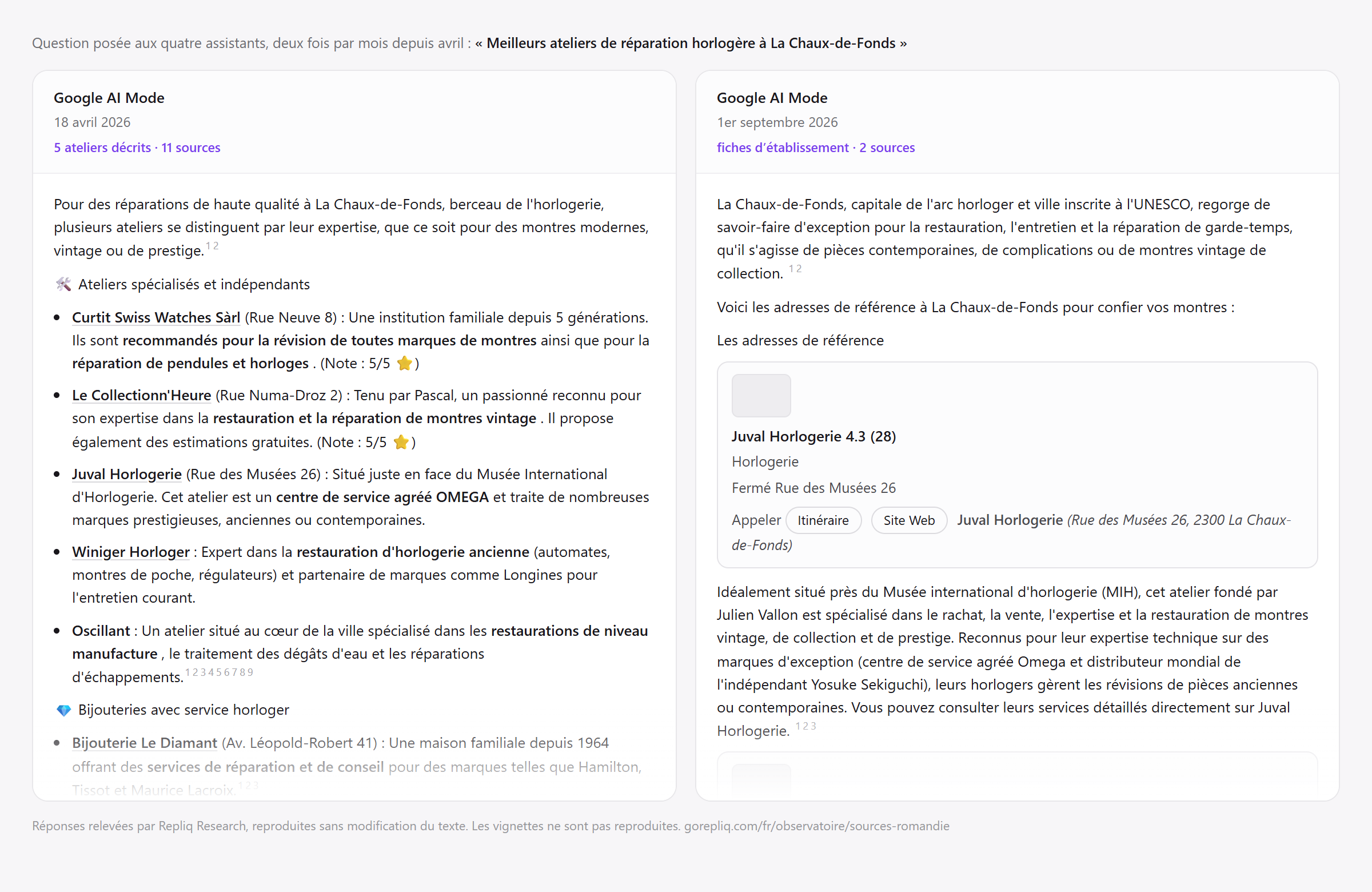
Answers recorded by Repliq Research on 18 April and 1 September 2026, reproduced without editing the text. Thumbnails are not reproduced.
The difference may look cosmetic. It is not really.
On 1 July, none of our questions produced that format. On 1 August, one in fifty. Since 15 August, one in nine. On local service searches (a tradesman, a garage, a repair workshop) the share is markedly higher than across our ten sectors as a whole, which is hardly surprising: nobody expects a business listing when asking which bank to choose.
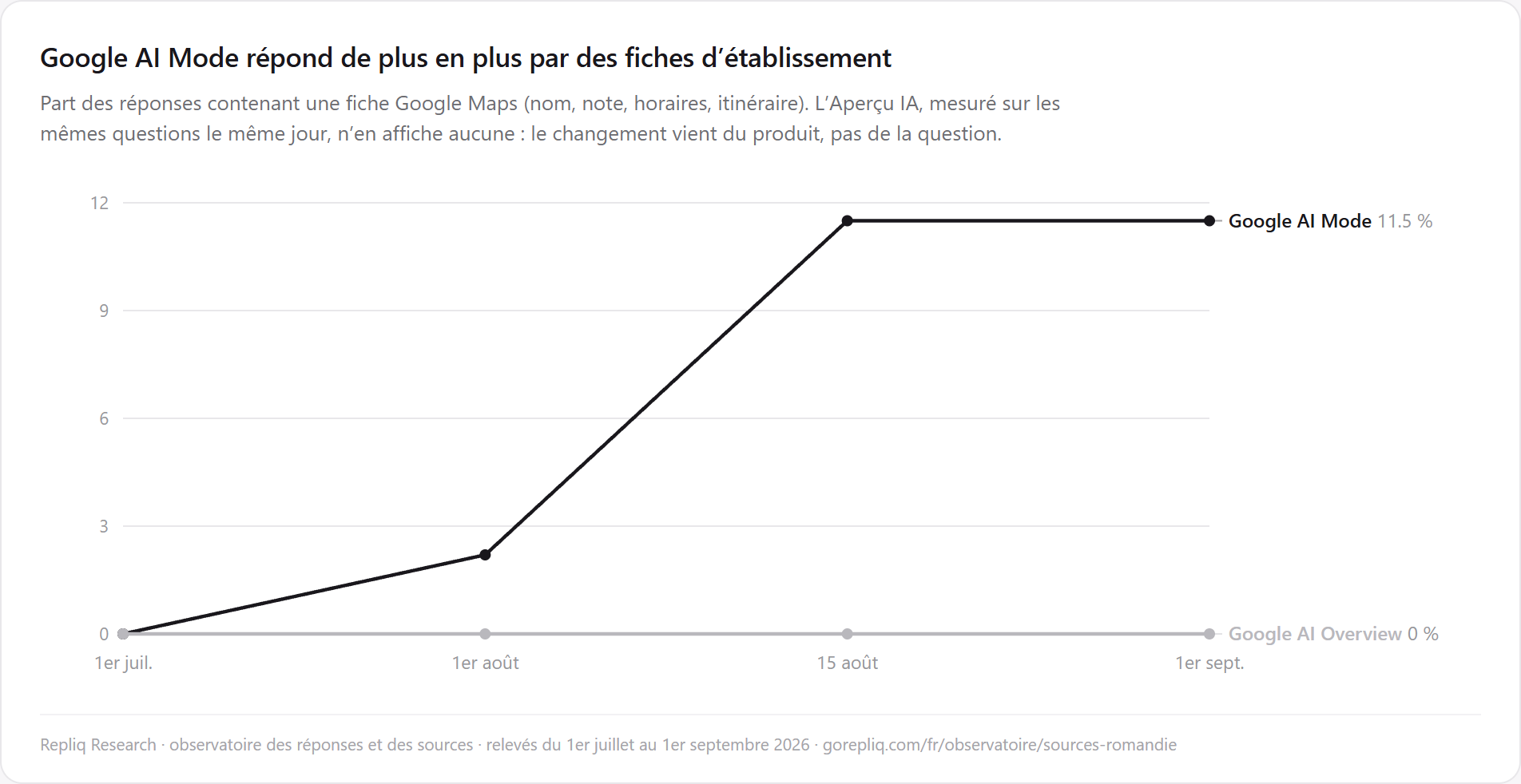
Repliq Research readings, 184 to 260 answers measured per point.
At the same time, the number of businesses named is falling: 5 per answer in April, 3.8 in early September. Answers naming no business at all also went from 4% to 10%.
Part of that drop is probably mechanical. A row of listings simply holds fewer names than a paragraph in which the assistant can run through a list. But the change of format has another consequence: what gets a business into the answer is no longer quite the same thing.
In a written answer, a workshop could stand out because one page explained precisely what it knew how to do. In a local listing, the chosen category, the address, the opening hours and the establishment's details carry mechanically more weight. That is how a brand manufacture that does not repair watches for the public can now appear next to a neighbourhood watchmaker.
For a local business, the Google listing is no longer just a complement to the website. On some searches, it becomes part of the answer itself.
Assistants show fewer of the sources behind their answers
The second change of the summer is less visible when you simply use an assistant: the number of sites shown as sources under the answers.
Between 15 August and 1 September, ChatGPT went from 9 cited sites per answer to 3.3. Google AI Mode went from 8.5 to 2.7. Over the same period, ChatGPT's answers grew 22% longer. The assistant says more, in other words, and shows the reader far fewer sites.
On some questions the change is particularly sharp. Take the best health insurer for a cross-border worker employed in Geneva. On 15 August, ChatGPT showed 28 domains: comparison sites, specialised forums, the Geneva press, insurers and public administration sites. Seventeen days later, the same question showed only two: ge.ch and priminfo.admin.ch. The answer itself had grown longer, from 2,644 characters on 15 August to 3,420 on 1 September.
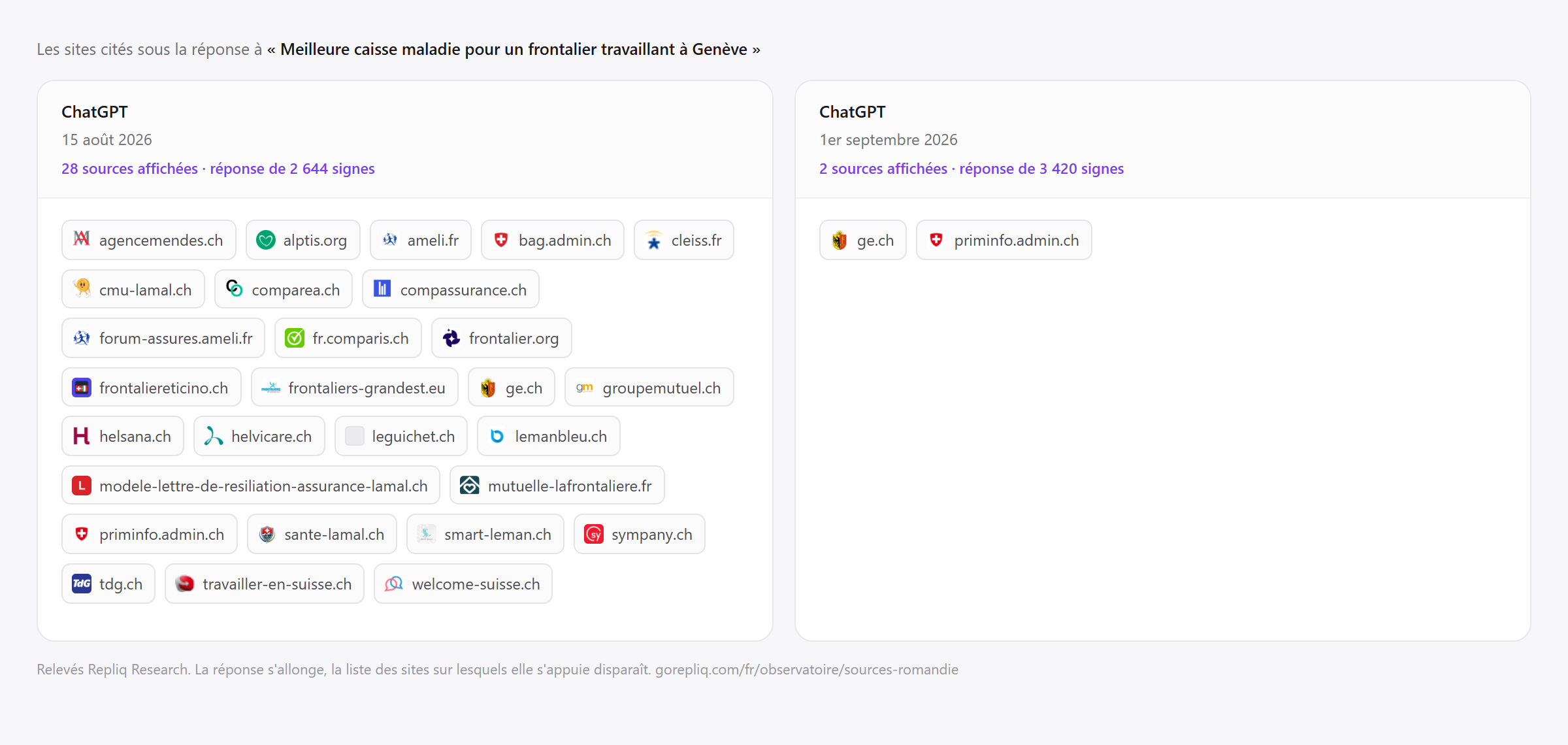
Repliq Research readings of 15 August and 1 September 2026.
It would be wrong to conclude that the assistant now uses only two sources to build its answer. We measure what is displayed publicly, not everything that happens behind the scenes. For a site publisher, though, the difference is real enough: there are simply far fewer visible slots under the answer.
And here too, the assistants do not all follow the same movement. Google AI Overview and Perplexity show roughly as many sources today as they did in July.
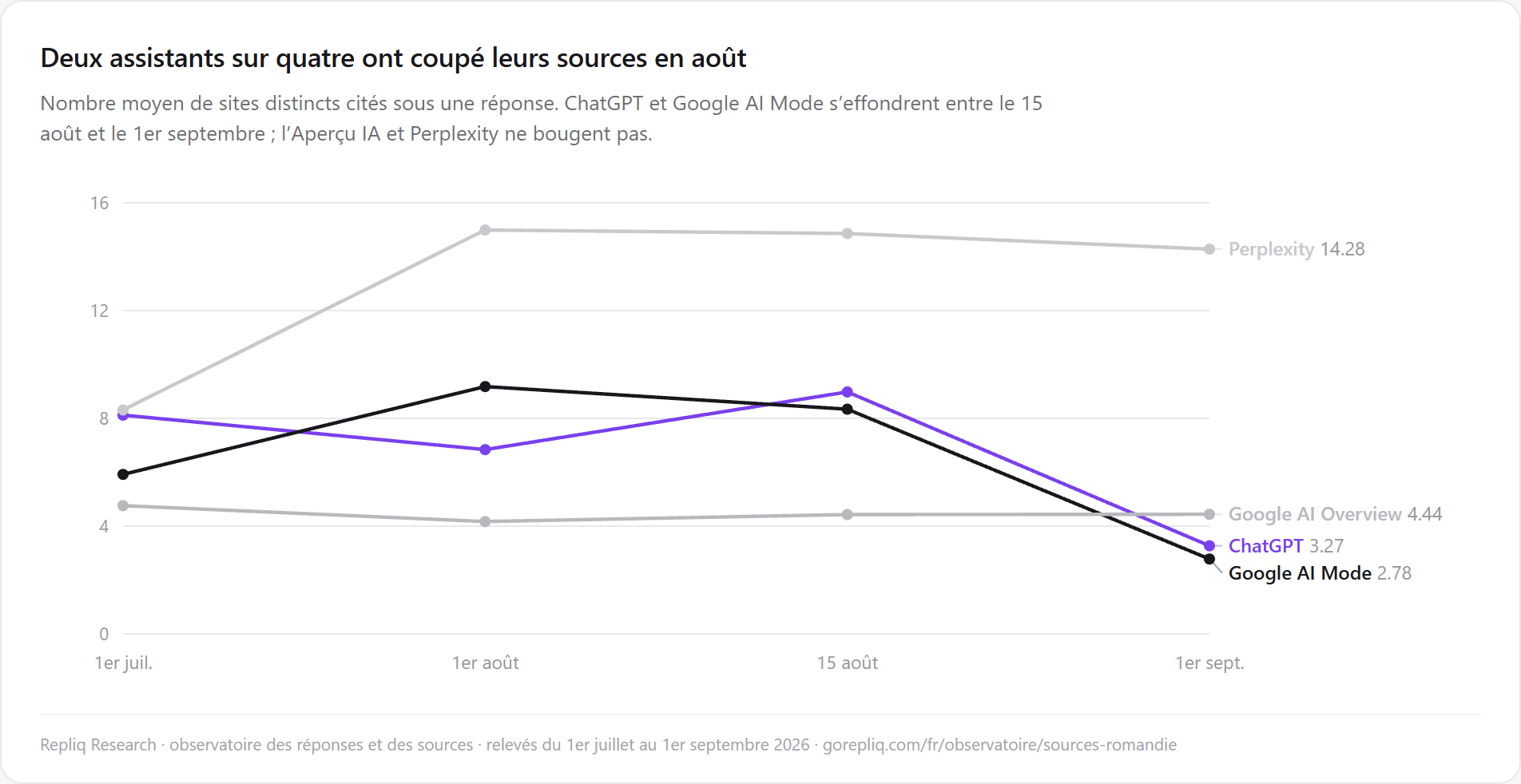
Repliq Research readings.
That makes a general phenomenon affecting all AI search unlikely. What we are seeing looks more like product decisions specific to each assistant.
Reddit has nearly vanished from ChatGPT
Reddit is probably the clearest example of how fast these balances can shift.
In early August, Reddit appeared among the sources of 15% of the ChatGPT answers we track. By mid-August that share had fallen to 6%. On 1 September it was below 1%.
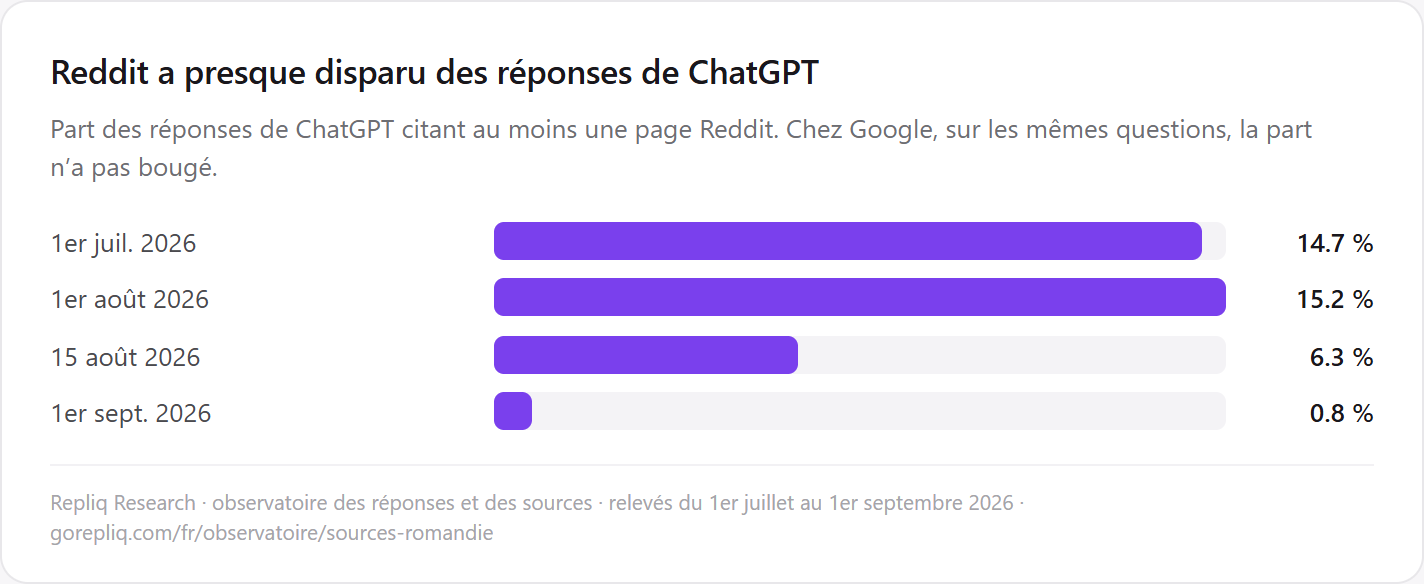
Repliq Research readings.
A French tool measuring its own domestic market observed the same three steps over the same period. Two measurements taken separately, in two different countries, show a very similar movement. At Google, on the other hand, Reddit's presence held steady.
The lesson is less that Reddit no longer counts than that a whole strategy should not rest on an assistant's presumed preference. A few weeks ago you could easily hear that Reddit was worth working on because ChatGPT cited it so heavily. That may well have been true at a given moment. Six weeks later, things already look very different.
The models change, their search systems change with them, and the list of visible sources can turn over very quickly. A tactic can be worth using without ever becoming a durable rule.
Where the answers come from, and what has not moved
The summer's changes are striking because they are easy to see: fewer sources here, more listings there.
The part I find most useful for a company, though, is the part that has barely moved since April: the general make-up of the sources.
Company websites account for 28.6% of our citations. Then come comparison sites and directories with 16.2%, official sites with 14.2%, independent blogs with 10%, the Swiss press with 6% and forums with 5.1%. In total, 50.4% of citations point to sites the company concerned does not own.
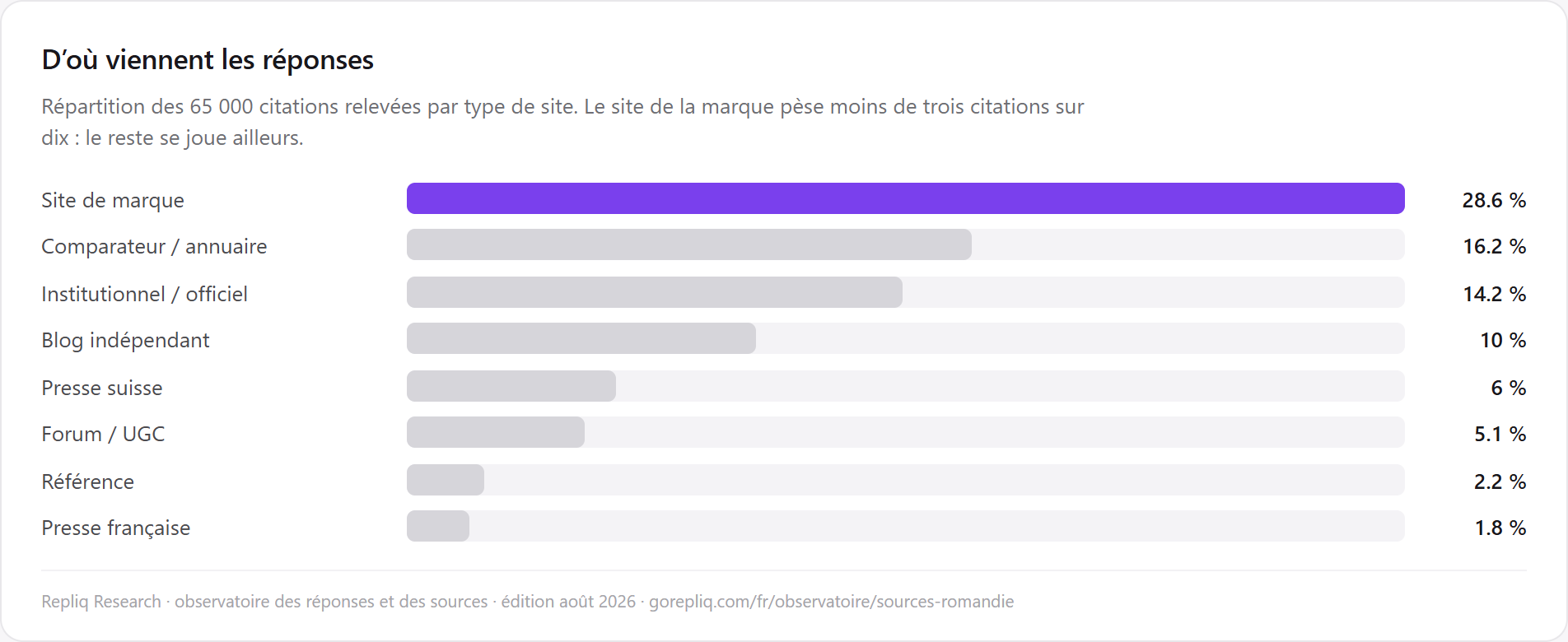
Repliq Research observatory, August 2026 edition.
That figure matters, because it is a reminder of something very simple: what an assistant says about your company was not necessarily found on your own site. Wrong, outdated or badly worded information can perfectly well come from a comparison site, a media outlet, a directory or an independent article. Fixing your own pages is therefore not always enough.
The sources also stay very local. 61.8% of citations come from Swiss sources, and .ch domains hold a large majority, against 28.8% for international sites and 6% for French ones. For questions asked in French about the French-speaking Swiss market, the assistants lean heavily on a Swiss ecosystem.
The press accounts for 6% of citations, with blick.ch leading over the period, ahead of 24heures.ch, watson.ch, rts.ch and letemps.ch. Independent blogs weigh more than the press, at 10% of citations.
Here are the ten most cited domains across the whole corpus:
| # | Site | Type | Citations | Share |
|---|---|---|---|---|
| 1 | reddit.com | Forums and reviews | 1,262 | 1.9% |
| 2 | youtube.com | Forums and reviews | 940 | 1.4% |
| 3 | fr.comparis.ch | Comparison site | 935 | 1.4% |
| 4 | moneyland.ch | Comparison site | 816 | 1.3% |
| 5 | google.com | Brand site | 676 | 1.0% |
| 6 | blick.ch | Swiss press | 507 | 0.78% |
| 7 | facebook.com | Forums and reviews | 437 | 0.67% |
| 8 | compassurance.ch | Comparison site | 429 | 0.66% |
| 9 | 24heures.ch | Swiss press | 394 | 0.61% |
| 10 | bonus.ch | Comparison site | 359 | 0.55% |
The top of that ranking moves very little. The twelve most cited domains sit in exactly the same order as in July, and you have to go down to thirteenth place to see the first change.
The Swiss press turns over slowly too. Among the 26 titles recorded, no new outlet has entered our corpus since July. Seven have dropped out of the top 200 sources: europastar.ch, agefi.com, rhonefm.ch, iamexpat.ch, lemanbleu.ch, presseportal.ch and arcinfo.ch. Most of them are specialist or regional outlets. When the number of visible sources tightens, the players cited least often are logically the most fragile.
There is no magic site either. The top ten domains together account for only 10.4% of citations, and the top hundred for 34.3%. You have to reach 500 domains to cover 59.7% of citations, while our corpus holds close to 8,000 of them. Working five or ten large sites is not enough to be present everywhere.
The type of page counts for a lot as well. 37.1% of cited pages are editorial content, 10.4% comparisons and 8.6% rankings. Product pages account for only 13.4%.
One result deserves particular attention: 19% of the most cited pages contain a passage we find word for word in the assistant's answer. A phrase published on a page can be picked up as it stands and end up in a summarised answer, without the reader necessarily knowing where it came from.
The pages that carry authority
Going down from the domain to the page, the ranking gets more interesting still. It is not necessarily the biggest brands that dominate, but often a few very precise articles, sometimes published by a single person.
| # | Page | Site | Citations |
|---|---|---|---|
| 1 | Meilleure banque Suisse (comparatif 2026) | mustachianpost.com | 106 |
| 2 | Top 5 des caisses maladie les plus avantageuses | compassurance.ch | 74 |
| 3 | Comparatif d'assurance maladie 2026 | fr.comparis.ch | 67 |
| 4 | Quelle est la meilleure banque suisse en 2026 ? | thepoorswiss.com | 62 |
| 5 | Quelle est la meilleure assurance maladie en Suisse ? | assurance-genevoise.ch | 60 |
| 6 | Meilleur courtier suisse : 6 facteurs pour choisir | schweizerfinanzblog.ch | 51 |
| 7 | Top 10 des banques en ligne en Suisse | hellosafe.ch | 48 |
Three of the seven most cited pages are personal blogs devoted to personal finance. And in our corpus, on questions about choosing a bank, an article published by a blogger under a pseudonym is cited more often than any page from a Swiss bank.
That is probably one of the most telling illustrations of what AI search changes. When a user asks which bank is the best, the assistant naturally looks for content that compares several banks. A bank can hardly write that comparison itself and be believed.
The power to recommend therefore shifts, in part, towards those who compare, rank and explain, not only towards those who sell the product.
Every sector has its own reference sources
There is no single recipe across sectors either. Education, real estate, restaurants and banking do not rest on anything like the same ecosystem of sources.
| Sector | Who dominates citations | Most cited source |
|---|---|---|
| Education | official sites 57%, brands 12% | orientation.ch |
| Real estate | comparison sites 41% | immoscout24.ch |
| Technology | comparison sites 36% | reddit.com |
| Health insurance | comparison sites 35%, official 18% | fr.comparis.ch |
| Mobility | brands 38%, official 29% | sbb.ch |
| Retail | Swiss press 24% | rappn.ch |
| Restaurants | forums 20%, directories 31% of pages | tripadvisor.fr |
| Banking | brands 34%, comparison sites 22% | moneyland.ch |
| Watchmaking | brands 28%, press 12% | youtube.com |
| Travel | brands 35%, Swiss press 17% | ebookers.fr |
Education and restaurants sit at opposite ends. In education, 57% of citations come from official sites and only 12% from the schools themselves. For a private institution, publishing more on its own site will not necessarily change much if the assistants build their answers from institutional sources.
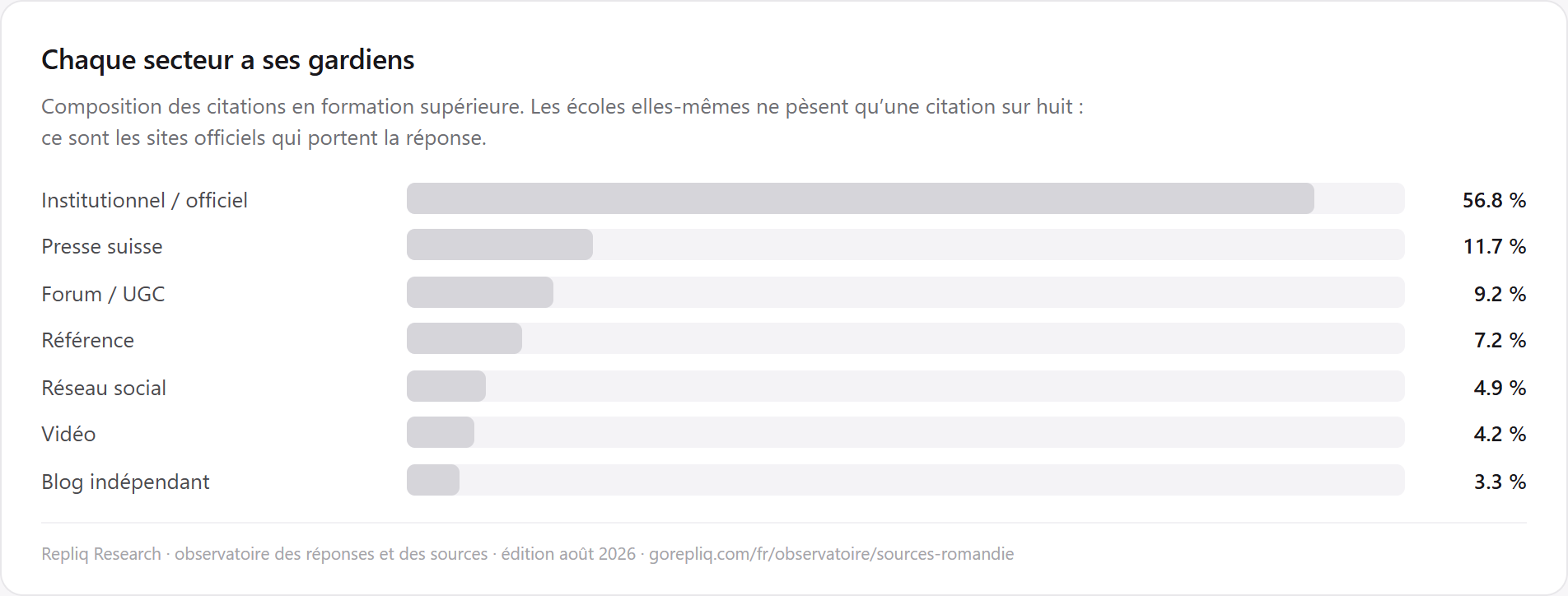
Repliq Research observatory, August 2026 edition.
In restaurants it is almost the reverse: forums and reviews account for 20% of citations, and close to a third of the cited pages are directory listings. In that context, being properly present on Tripadvisor, Google or other platforms can count as much as publishing another article on your own site, and sometimes more.
The same contrast shows up between mobility and real estate. In mobility, brands and public sites together account for about two thirds of citations, while comparison sites weigh only 9%. In real estate, four citations in ten go to comparison sites instead.
The consequence is simple enough: before producing content, it is worth looking first at who carries authority in your sector. A new blog article does not have the same value if the assistants lean mainly on Comparis, Reddit, a public administration or Google Maps.
There is no single AI
This is probably the point I most underestimated when the observatory started. People readily talk about visibility in AI, as if there were one engine with a few shared rules. Our readings show four products, each moving at its own pace.
The corpus holds close to 8,000 domains. Fewer than 8% of them are cited by all four assistants. Two in three are picked up by a single one.
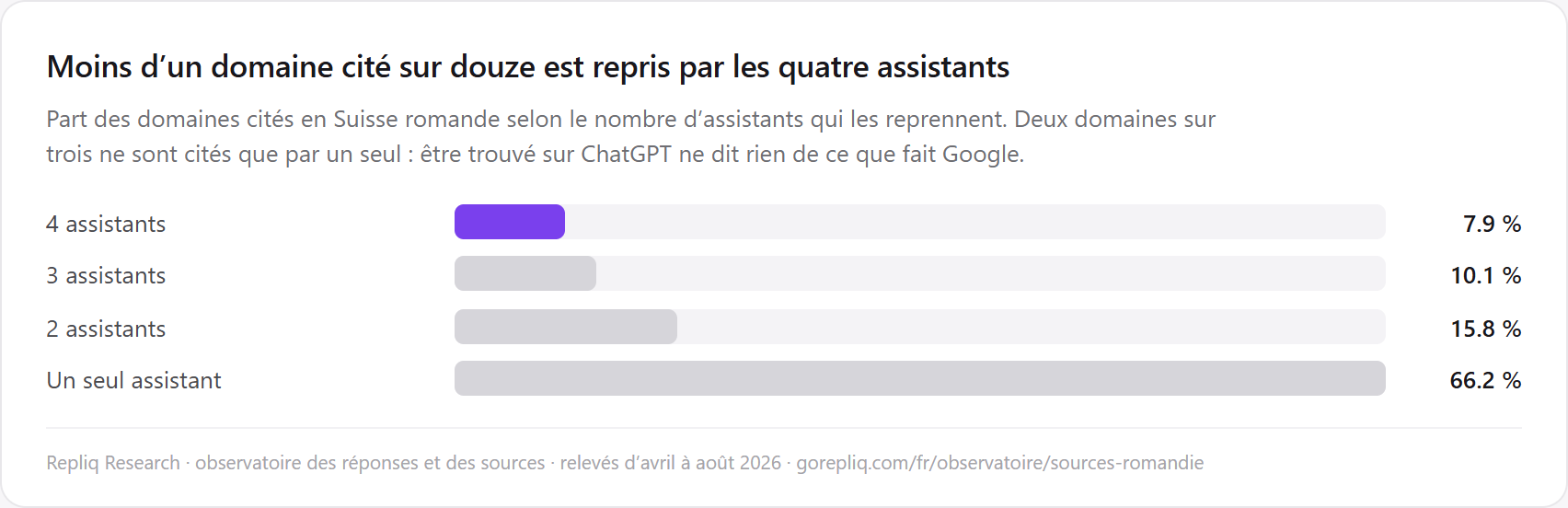
Repliq Research readings, April to September 2026.
Being easy to find on ChatGPT therefore tells you nothing about what happens at Google, and the other way round.
Their sourcing habits differ too. After brand sites, ChatGPT and Perplexity turn more readily to comparison sites, which account for 21% and 19.9% of their citations respectively. Google's two surfaces give more room to official sources, at 15.9% and 17.4%.
For a company, that makes overall averages fairly misleading. Saying that a brand is 60% visible in AI may sound practical, but the figure sometimes hides very large gaps between assistants. Better to look at them separately, and to accept that a method working well in September may lose part of its value a few months later.
What this changes for a Swiss SME
All of this can turn technical quickly. In practice, I would hold on to four things.
Keep your Google Business Profile current. The right category, opening hours, address, services offered and recent reviews become particularly important as soon as Google answers with local listings rather than with text.
Watch what is said about you elsewhere. About one citation in two in our corpus comes from a site the company does not own. Comparison sites, directories, media, sector platforms and official sites can therefore weigh directly on how an AI presents you.
Publish what you are genuinely well placed to explain. A watchmaker showing why a movement can stop after a poor service brings something that yet another article on five tips to look after your watch does not. As generic content multiplies, real experience becomes more interesting.
Measure assistant by assistant. Visibility rate, share of voice against competitors, the sentiment attached to the brand and the position in recommendations already give a good reading, as long as you do not blend everything into a single average.
Advertising is coming, but it is too early to draw conclusions
There is one piece of context I find worth noting.
While we were observing these changes, OpenAI and Google began gradually opening up advertising formats around their AI experiences. OpenAI launched ads in ChatGPT in the United States before extending its campaign manager to several markets, and Google is testing ads in AI Mode with a set of American accounts. Switzerland is for now part of neither rollout.
It would be tempting to connect the two: fewer visible organic slots on one side, paid slots arriving on the other. Our data does not support that. We are looking at a coincidence in timing, nothing more.
For a Swiss company it still says something about how to prepare. When advertising arrives, it will probably come on top of answers that continue to be built from sources, listings, comparison sites, media and existing content. A solid organic presence will remain the base: accurate information, a well-kept local listing, third-party sources that describe the company correctly, and genuinely useful content. Paid placement will then complete that base for certain needs.
Investing today in an advertising channel that does not yet exist in Switzerland would be premature. Waiting for it to arrive before working on the rest would be no wiser.
Method
We track close to 200 fixed questions spread across ten sectors of the Swiss economy, asked twice a month since April, directly in the public interfaces of ChatGPT, Google AI Mode, Google AI Overview and Perplexity, not through their APIs. The figures in this article cover the August 2026 edition of the observatory: about 65,000 citations, close to 8,000 domains and 25,000 distinct pages.
To count the businesses recommended, we include only those genuinely offered to the reader as a choice. In a phrase such as "Juval Horlogerie, authorised Omega service centre", the reader can choose Juval Horlogerie, not Omega.
The comparisons presented here are paired: same question, same assistant, from one reading to the next.
Limits
Our readings show what the assistants do, not why they do it. We do not know why Google changed certain answer formats, nor why ChatGPT now shows fewer sources.
Nor can we isolate precisely how much of the drop in businesses named comes from the change of format itself: a row of listings is mechanically shorter than a written answer.
A business listing is identified by the directions link Google places under each card, the only marker present in every listing and absent from a written answer. The share we publish covers all ten of our sectors, many of which are not local searches: it sits lower than what a neighbourhood business would see on its own queries.
The questions in this observatory are asked in French and concern French-speaking Switzerland.
The data is public and updated every month: https://www.gorepliq.com/fr/observatoire/sources-romandie
Frequently Asked Questions
Which sites does AI cite most in French-speaking Switzerland?
Across the 65,000 citations we have recorded since April, reddit.com comes first with 1.9% of citations, ahead of youtube.com, fr.comparis.ch and moneyland.ch. No single site dominates: the top ten domains together account for only 10.4% of citations, and you have to add up 500 of them to reach 59.7%. The sources are also very local, with 61.8% of citations coming from Swiss sites.
Why does my company not appear in ChatGPT when it does well on Google?
Because they are two different products, drawing on different sources. Of the close to 8,000 domains cited since April, fewer than 8% are cited by the four assistants we track, and two in three are cited by a single one. ChatGPT and Perplexity turn first to comparison sites, Google's two surfaces to official sources. Being well placed on one therefore tells you nothing about the other.
Should I work on my website or on my Google listing to be recommended by AI?
Both, but not for the same questions. On local searches, Google increasingly answers with business listings drawn from Google Maps: the category, the address and the opening hours on the listing then weigh directly on whether you appear in the answer. On comparison or advice questions, content is what counts, and 50.4% of citations go to sites the company does not own.
Does publishing blog articles help you get cited by AI?
It depends entirely on the sector. In higher education, 57% of citations come from official sites and only 12% from the schools themselves: one more article on your own site changes little there. In restaurants, forums and directories dominate. In banking, the most cited page in our corpus is a comparison published by an independent blogger, cited more often than any page from a bank. Look first at who carries authority in your sector.
How do I know whether an AI talks about my company?
By putting the same questions to the assistants regularly and recording what they answer. A single measurement says almost nothing, because these engines are probabilistic and their settings change quickly: Reddit went from 15% to less than 1% of ChatGPT answers in a month. Four indicators are enough to follow over time, the visibility rate, the share of voice against competitors, the sentiment attached to the brand and the position in the answer, as long as you read them assistant by assistant.
Will AI assistants replace Google search optimisation?
Nothing in our readings points that way. The assistants rely on existing web pages, and the content that helps people decide, comparisons, rankings and guides, makes up the majority of the pages cited. The work changes target rather than nature: it is no longer only about reaching the top of a list of links, but about being picked up in an answer written from third-party sources.
Measure your AI visibility
Discover how ChatGPT, Google AI Mode and Google AI Overview talk about your brand. One-shot audit or continuous monitoring — your call.
Discover the AI visibility auditRelated Articles
When AI gets your company wrong, the error rarely comes from your site
The investment of recent years went into the website: the right information, navigation that leads the user to the right page. AI now reduces all of that to an answer a few lines long, drawing 90 % of its cited pages from third parties, from comparison sites to directories, press and forums. One answer in 14 carries at least one false statement, and every organisation we track has one in circulation. Repliq's Reliability feature compares each measured answer against your official information, then traces the page feeding the error.
From search to recommendation: who answers for your brand in AI?
AI is turning information search into a direct recommendation where users expect arbitration. Our study of 8,800 citations shows that leading Swiss brands today control only 5 to 12% of their own narrative inside these interfaces. This guide unpacks how challengers like rappn and Magic Heidi break through with structured content, and how established brands can reclaim the conversation by becoming reference sources for the algorithms.
Google AI Overview: when it actually appears
AI Overview is the text Google displays above the links, written by the AI at the moment of the search. Across more than 2,800 questions asked in French-speaking Switzerland, it appears in three cases out of four. The rate drops to 23.4 % on price and purchase searches, which is where your customers decide. The sources it cites are not Google's top results, and they change completely from one national language to another.